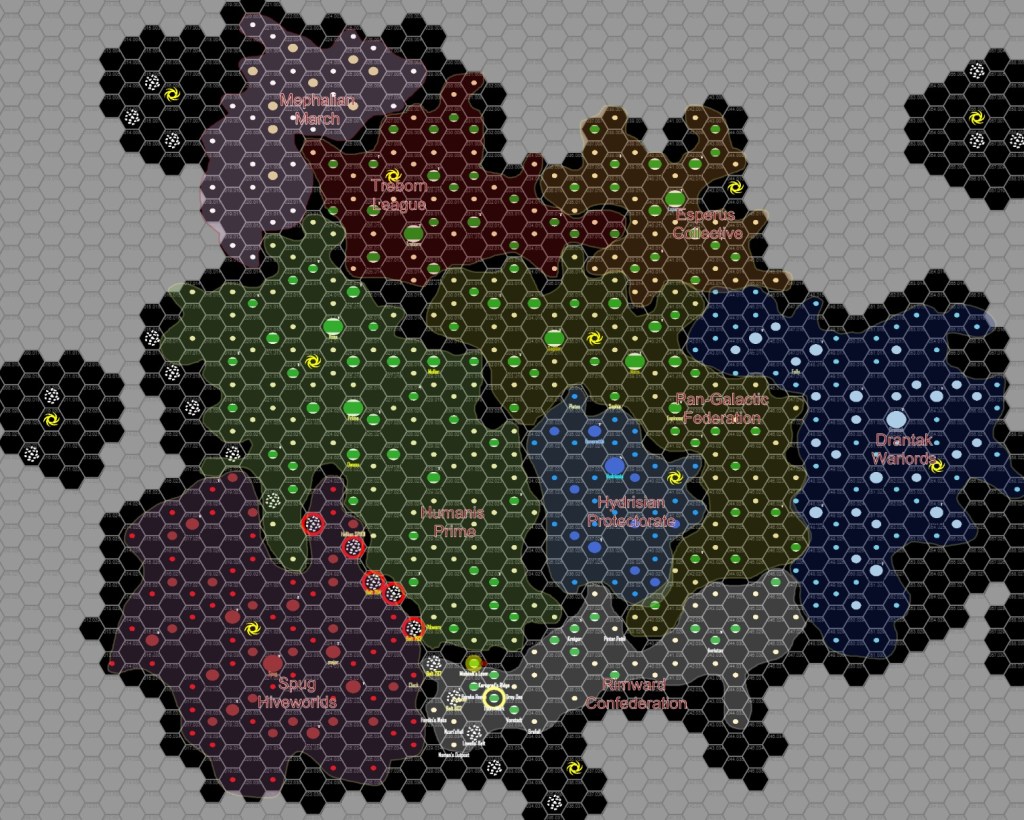
My setting is largely TL 8 to 10 with Starships being TL 12. Humanity was scattered among the stars roughly 2000 years ago with Iron Age technology and no recollection of their homeworld, only the skills and culture they possessed at the time, and then moved forward. About 200 years ago, Star Travel was discovered simultaneously on the seven known homeworlds. (The Esperus have some theories about this).
Alien races are inspired by various lines of miniatures by Spriggan Games, Alpha Forge (Star Mogul) and others that I cannot recall. I don’t know anything about the original cultures they were supposed to represent, so I made my own. The setting is always a work in progress!
The Conclave: The Conclave is an interstellar assembly designed to prevent human on human warfare, adjucate trade disputes, encourage internal trade, development exploration, colonization and steady population growth with a higher quality of life for all. It was established in 176 (a date it determined by member vote, which also established as year zero the near simultaneous invention of the warp drive by all member nations and the adoption of the Treburne solar cycle as the measure of years, and its seven, twenty four hour week as standard units of time). Most of these goals are aspirational in nature as the Conclave only has two functional tools at its disposal, a “Contracts and Commerce Court, that handles trade disputes and the “Conclave Scout Service” which operates communication relay craft, survey teams within settled systems, and exploration craft along the frontier. Originally funded by a sizeable donation of funds from the Treborne league, it is now funded by postal fees and contract taxes collected by its tiny galaxy spanning bureaucracy.
Location: The Conclave is headquartered on “Princip Station”, which orbits around Treborn Alpha. The station contains meeting and lodging rooms for the five member High Council and their staff, a great hall, designed for fifty delegates, that serves the 33 member General Assembly, along with offices and lodging rooms sufficient for a 50 member General assembly, plus offices and meeting space for the Contracts and Commerce High Court, and for the leadership and strategic planning offices of the Conclave Scout Service” The station is a sprawling affair with multiple docking pads and multiple missile and laser batteries, and five small rotating detachments of marines from each member state for security along with a permanent security commander and team.
The High Council: The High Council Consists of Five Members and discusses what authority to grant the Conclave, how to ensure each power’s interests are fairly served and to hash out any disputes. Major issues are determining who should settle and govern a newly discovered system. Whether a system should be colonized at all, and which worlds should be further surveyed for future growth and potential.
The General Assembly: The General Assembly has 33 members and deals with the same issues as the High Council. When there are disagreements, both bodies must agree on any new policy on how to settle the dispute before the Conclave handles a decision.
Contracts and Commerce Court: The courts deal with the adjucation of major trade contracts, especially between entities from different nations, where language and base understanding of contracts may greatly differ. The court’s rulings are considered binding on private entities within a member state, and the court is authorized to issue fines and orders of empoundment which member states have agreed to enforce on the court’s behalf.
Conclave Scout Service: The Scout Service was established in 185. Its primary function is intergalactic communication with postal boats hopping continuously from one system to the next, transmitting news to habitable worlds and other relat boats, occasionally delivering physical mail (though traders do this more often as the relay ships don’t actually need to dock), then bouncing back to their origin. Most relay scouts see the same two systems week after week for their entire 4 year term. Secondarily is exploration at the fringes of space, and finally, survey of worlds within human space to improve local knowledge
All of these missions have some risk of exposing “state secrets”, so relay scouts are approved by member states for their routes. Exploration and survey crews are told what route to follow (if flying a ship rather than passengering) to get to their mission sector, and some systems are simply off limits to scout ships with their advanced scanners.
The first wave of scouts were pooled from member nation’s navies, as well as civilian recruits, and the first wave of ships were donated military surplus. Now they have a more uniform configuration. And scouts…are a bit more cosmopolitan than most military spacers, a little more suspect to local authorities, and immediately remove themselves and their intelligence from human vs human conflicts.
Controversies: The original proposal for the conclave stated all worlds with more than 1 billion inhabitants should have a seat on the General Assembly. This was amended to count only human inhabitants, thus removing a number of Pan Galactic worlds from the Assembly and also nullifying their efforts to bring the Hydrissian Protectorate into the organization. The High Council was initially proposed to have one seat per Home World, resulting in a seven member council, but that gave two votes to every power but Esperus, though it was also argued that Treborn Alpha and Beta, being located within the same system, should only receive one seat. So the decision was made to have one seat per member state, but Esperus refused to join as an even number of member states, Humanis, Pan Galactic, Treburn and itself would result in frequent tie votes. IT was suggested that the Emperor of Treburn, who initially proposed the Conclave and was the man who brought the four powers to the table to discuss the concept should be the fifth, tie breaking vote, but he declined so as to avoid placing his lineage back in a position of actual, rather than symbolic, authority or creating the impression that the Conclave is biased towards Treburne interests. He proposed offering the fifth seat to the recently formed Rimward Confederacy over the objections of both Pan Galactic and Humanis, but with strong support from Esperus. After the 1st Drantak war, Pan Galactic and Humanis both eventually removed their objections and the Conclave was formally adopted after 18 years of discussion (and four years of serious consideration and debate). It has now been in operation for twenty-five years and has coordinated a combined humanity wide response to two alien incursions, the 2nd Drantak and 5th Spug war, settled innumerable trade disputes and spearheaded a number of local survey efforts.

Humanis Prime: Well organized, highly militarized human exclusive nation focused on gradual expansion, consolidation. Conquers and subdues worlds. Sentient aliens are either quarantined, eradicated or enslaved as they are “less than” or dangerous (First contact was with the militaristic alien “Spugs”)
(Church of Enlightenment, Church of Reaping, Church of Founders)
(Homeworlds:
Prime, population 12 billion, overcrowded cities, polluted, heavily industrialized, (Use Ghanan names and Central African appearances)
Voss: population 6 billion, mixed, settlement patterns, breadbasket) (Use German names and Slavic appearances)
Humanis: Governed by the high admiralty, which appoints from among its ranks a single Lord Commander. He appoints, with admiralty approval, sector commanders who govern all military and colonization efforts in that region. There are sub offices of the admiralty that handle “civilian” matters, labor, production, justice, education, but the main focus is military preparedness. Ascension through government is meritocracy based, promotion through performance.
Marriage and Family: The nuclear family is the normal household type. Individuals are encouraged to marry for love, provided that genetic screening does not reveal some sort of dangerous recessive trait likely to cause physical birth defects among any offspring. Civilians are expected to raise their children in the home, house them and send them to state sponsored day schools to learn basic trade skills. Military families are encouraged to enroll their children in high quality, government run boarding schools where they may be trained from an early age for military service. Civilian parents aspire to have their children admitted into these schools a as well, but priority is always given to the children of military personnel. raise children send them to school, house them at home. Adult civilians often marry shortly after establishing themselves as economically self sufficient. This typically takes place between ages 22 and 30. Members of the military often defer marriage until after age 26. Same sex marriage is legally recognized, and though procreation though such a union is impossible, military couples will often adopt orphaned children of other military personnel, or even children whose civilian parents hope that transfer to a military family will open better opportunities for their offspring. In these cases, both the natural civilian parents and the adoptive military parents maintain a shared interest in the child’s future well being, though legally, the military parents are the legal guardians.
Housing: On most worlds, civilian families (mother, father, minor children) live in small domiciles attached to a common area that serves other family domociles. The common area contains kitchen and dining facilities as well as a communal recreational area. The family’s sleeping domicile is considered “private”, but residents of any domicile can invite guests to the shared facilities. Unmarried civilian typically live in structurally similar building, but instead of sharing a domicile with a spouse and children, they will share with two or three other unmarried adults. Unmarried military personnel are lodged similarly, though often in larger barracks housing a larger number of individuals. Married and high ranking military personnel my have what Federation members would recognize as truly private quarters with individual bedrooms for household members, and semi private shared spaces to which the head of household maintains access control. bedrooms for each child, a shared room for the adults, a kitchen, and a communal shared space for household members.
Diet: Humans, being omnivores, can eat a wide range of foods. The Humanis diet relies heavily on animal proteins and enriched grains. Loaf breads, sliced meats roasted until tender, or salted, canned and preserved are common. Food tends to be fairly bland to the taste of most foreign palletes, but is hearty, filling, long lasting and easy to prepare.
Education: The Humanis operate communal schools to train the civilian population for work and possible recruitment into the military. Civilian children from roughly age three years to eighteen, depart from their family homes each morning, spend six to eight hours being taught reading, writing, mathematics, history and physical fitness. At age twelve, civilian students are given an assessment to determine occupational fitness, and then begin receiving specific career training that balances personal talent, state need, and parental input, with the needs of the state being of primary consideration. Selection for military service is culturally considered desirable, though there are individual differences of opinion. The children of miliary households are enrolled directly into military boarding schools with similar curriculum to those of civilian schools, but with more rigorous physical fitness, longer hours and additional martial and tactical training from the earliest ages. Occasionally a student might “wash out” and be expelled to civilian life as an adult, bringing shame to their parents, but most are funneled directly into the armed forces at the age of 18. While broad careers are determined by the needs of the state and training provided throughout adolescent years, most training is broad enough that there is room for some personal choice in specific assignments as an adult.
Medicine: Health care is provided by the state. Availability of care depends on planetary resources, local tech and the patient’s (or their parent’s if a minor) value to the state. Military service and rank have their privileges. There is no cost to the individual for state provided health care. If the state denies care, it is perhaps possible to discreetly hire a physician to do some work or prescribe some medicine illicitly, but this can be a risky and expensive undertaking.
Law: Laws against property theft and interpersonal violence are strictly enforced. Law enforcement is a military function, and cases are heard by military officers assigned to enforce civil peace. Capital punishment is employed against any criminal whose actions “endanger or undermine” the state. Financial penalties, forced servitude, transfer to hazardous duty stations or imprisonment are penalties for lesser offense. Sentences are “for life” or until good service redeems the condemned.
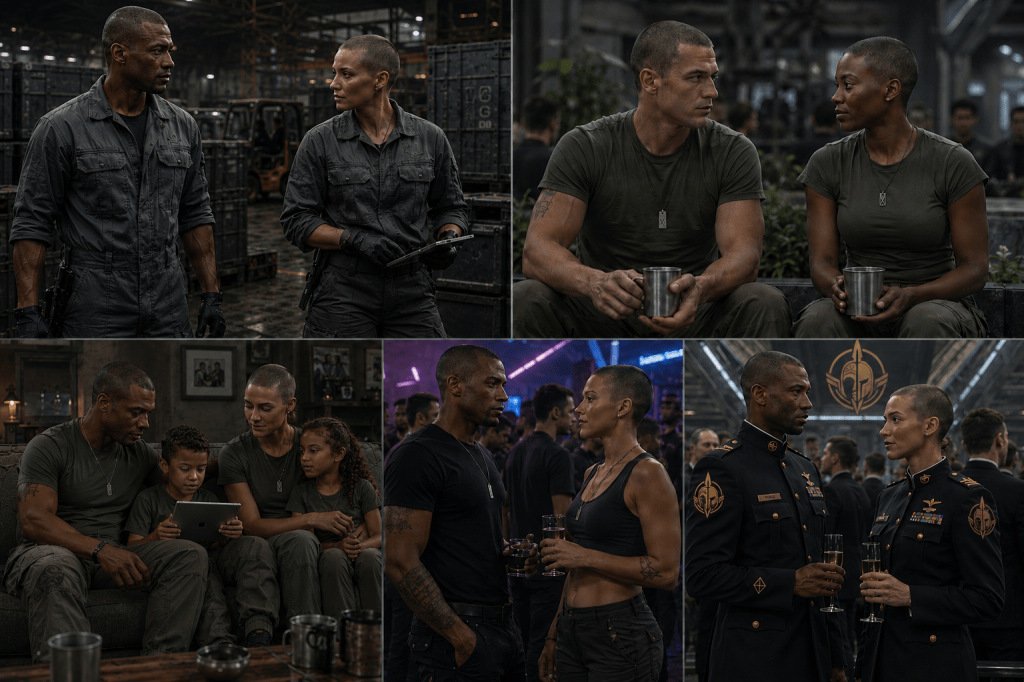
Fashion: Functional practicality defines Humanis fashion. Civilians tend to wear single piece jump suits in a work environment or multipiece pants, tunic and undershirt combinations that mimic the style of dress for enlisted military personnel’s work fatigues. That is the same style of clothing worn by military personnel in daily wear, but is replaced by close fitting, crisp lined, and well decorated dress uniforms in formal settings. While daily wear is nearly devoid of ornamentation aside from rank, name and unit insignia, formal wear tend to be adorned with symbols that detail a person’s entire career. Colors are muted, generally matching the planet’s flora, earth and skyline. Male and female attire are identical in basic style, though cut varies to fit the body type.
Humanis wear hair buzzed short and despise facial hair. Arm tattoos indicating corporate or unit affiliation are popular, though on convicts, such markings are blotted out, and if not present, a block is inked on in the usual spot so convict status is clear. Humanis shun jewelry as well. Makeup use, aside from combat camo, is non existent.
Weapon Restrictions: Civilians may not own weapons in Humanis space except under special dispensation on certain colonies. Veterans may own personal service weapons, but can only pass them on to military or fellow veteran heirs. Veterans may openly carry handguns, knives or long blades, as may off duty military personnel. Restrictions are lessened in colonial environments where indigenous threats may exist.
Religious Practice: The three major religions in Federation space are the Church of Founder, Church of Enlightenment, and the Church of Reaping as they are legally recognized schools of thought.
Work Culture: Humanis utilizes a seven day “work week” with three standard “watches”. Most personnel work one watch, rest one watch, then sleep one watch for ten consecutive days followed by four consecutive days for training and recreation. The length of a shift varies based on local custom, though the navy follows the shift schedule of Prime. Military personnel are often granted a six week leave period once per year for personal recreation and travel. Civilian personnel may receive week long leave periods as rewards for good and loyal service, and these rewards typically become more common after lengthy periods of service. Work assignments are made by the state, and personnel may not unilaterally separate themselves from their work assignment (see undermine the state) but may request assignment transfers which may or may not be granted depending on the needs of the state and the local commander’s consideration of the application and applicant’s character, loyalty and proven work ethic.
Entertainment: Humanis work hard and play hard. Music is popular among all segments of the population, but not for listening, but to drive vigorous and intense dancing. While many songs have lyrics, it is the beat that matters most. Competitive team sports are popular past times and are organized between rival military units at an installation or between civilian work groups planetside. While there are some high tempo low or non-contact sports, like Federation football, Humanis also practice high contact sports where physical strength and overpowering one’s opponents is fair play. Additonally, non-lethal bloodsports are also enjoyed, like boxing, wrestling and other combat sports. “Low-contact” sports generally include both male and female on the same teams in matching ratios for competing teams, but high contact and bloodsports are normally restricted to “like” adversaries.
PanGalactic Federation: Well organized human dominated nation focused on interstellar trade, cooperation, expansion. Includes absorption/enculturation of compatible sentient species (First contact was with peaceful alien neighbors, the Hydrissians)
(Church of Founder, Church of Enlightenment, Church of Galactic Consciousness)
Homeworlds:
Mara: Population 8 billion, industrial, advance tech, highest standard of living in known human space. No major land masses the size of earth continents (Use Spanish names and Appearances)
Sagitar: Population 4 billion, mixed settlement patterns, breadbasket world, high standard of living (Use: Use Indian names, Indian/West Asian appearances
Governance: Governed by a high council made up of one representative from each world over 1 billion in population, and low Council made up of one representative per billion sapiens in a region of space (one rep from multiple adjacent small systems, or multiple reps from a single densely populated Lord). Matters of war, trade and law are decided by the agreement of both bodies, and policies are executed by the tribunes. Three individuals elected from within those bodies (and replaced upon election). One focuses on commerce and foreign policy, one on law, education and domestic policy, the last on colonization and military policy
Marriage and Family: The nuclear family is the normal household type. Individuals are encouraged to marry for love, raise children send them to school, house them at home. Children are highly valued by society, parenthood glorified, tax breaks provided to support child rearing, and education. Same sex and interspecies marriage are not recognized, but unusual living relationships are not punished or prohibited. Adults often marry shortly after establishing themselves as economically self sufficient. This typically takes place between ages 22 and 30. Marriage is often pledged for life, but serial monogamy is common as divorce is a recognized resolution to insurmountable personality conflicts within a household.
Housing: On most worlds, families (mother, father, minor children) live in small domiciles complete with all of the amenities required to support family, individual bedrooms for each child, a shared room for the adults, a kitchen, and a communal shared space for household members. These may be free standing “houses” on low population worlds, or apartment type structures in high population centers. These living spaces are considered “private” and while guests are often received in communal areas, sleeping areas are considered “intimate” and non-family members are not normally welcome there.
Diet: Humans, being omnivores, can eat a wide range of foods. However, in the Federation, diet leans heavily towards vegetable and grain products, with pasta/noodle based meals, often infused with ground insect protein supplements and vitamins are the stable core of most meals. Mara consumes a high volume of fish, and this is the primary type of protein in Federation dishes. Cheeses, eggs and milk are also consumed. Mammalian animals are not consumed, and following the discovery of Hydrissians, reptiles also fell off the list of valid protein sources. There is a movement to removed fish and insects from consumable diet as well, though the “fish free” faction, pointing towards Selkies as “fish can be people too” has much greater support than the “insect free” faction as Spugs are noticeably larger than anything normally encountered in human space.
Education: The Federation operates communal schools to train its younger members. Children from roughly age three years to eighteen, depart from their family homes each morning, spend six to eight hours being taught reading, writing, mathematics, history, political and hard sciences, then returning home in the evenings. After age eighteen, children are expected to leave their family home and either enter University for advanced training or embark directly into a career. Careers are chosen by the individual based on personal talents, interest and the willingness of an employer to hire them. Family connections and personal references help a great deal.
Medicine: Health care is provided by private institutions and physicians are respected professionals. Availability of care depends not only on planetary resources and local tech, but also on the financial resources of individuals seeking care or the willingness of their employers, friends and family to contribute to covering costs.
Law: Laws against property theft and interpersonal violence are strictly enforced and protection extends to both humans and to recognized sapient non-humans who are legally within Pan Galactic space. Civilian law enforcement agencies are part of local governments, and a judiciary whose judges are appointed by the state hears all matters of criminal cases and civic contract disputes. Capital punishment is reserved for crimes of murder. Otherwise, financial penalties or imprisonment for fixed terms based on a schedule of crimes and appropriate punishments are the norm.

Fashion: Humans in the Federation favor snug leggings and a tunic or dress over the torso. Bright colors are favored, as are embroidered patterns. Where ease of movement is necessary or hazardous machinery are present, the tunic is replaced with a close fitting shirt.
Pan Galactic males typically wear their hair no longer than shoulder length, females maybe to mid shoulderblade. Hairstyle is “whatever nature decides” though combed and maintained, and tied up when necessary. Tattoos are uncommon, but reflect personal interests. They are generally concealable. Rings, earrings and bracelets are popular, while facial piercings significantly less so.Make up use is for modest accents
Weapon Restrictions: Weapons are not normally carried by civilians in Federation space. Private ownership of handguns and shotguns, as well as long and short blades are allowed for home protection, however, carrying such weapons within a community is largely prohibited. Hunting (and fishing) are not legal pastimes in Federation space, so even single shot rifles are not legally owned by civilians. Veterans may own personal service weapons and pass them down to their heirs. Restrictions are lessened in colonial environments where indigenous threats may exist.
Religious Practice: The three major religions in Federation space are the Church of Founder, Church of Enlightenment, and the Church of Galactic Consciousness as they are legally recognized schools of thought.
Work Culture: The Federation recognizes a seven day week and a five day “work week” with three standard shifts. Most people will work five standard shifts per week, each on a different, usually consecutive day, and then have two full days off work for family, entertainment, worship or other personal reasons. The length of a shift varies based on local custom or that of the homeworld of the original colonizers of a world. Most employers also grant longer leave periods and allow time off for illness with a certain maximum number of days that varies according to an employees skills and tenure as part of the employment contract. Employment is arranged by contract for a predetermined period of time. Breach of contract either by neglect of duties, sudden resignation, or sudden termination by the employer, is a breach of civil law and subject to adjucation and potential fines and compensation towards the injured party.
Entertainment: Federation members enjoy a range of auditory and visual entertainment, most notably music and “film”, as well as live performances on stage of both visual stories and music. Physical sports are second in popularity with many communities having “football” teams that compete against those of other communities, often to be broadcasts and as the focus of gambling and community pride, and smaller teams that compete locally in less formal games between families, friends, local schools, work groups and the like. Bloodsport is not legal in Federation space, and competitions of a physical nature are restricted to “like” adversaries: Male vs Male human, Female vs Female human, Hydrissian vs Hydrissian (for who can tell male and female apart).
Esperus Collective: Small human power ruled by a psychic aristocracy that holds humanity is but one step in a greater ascension. Otherwise, functions as a militaristic state. Aliens are assigned value based on psychic resonance, either revered or enslaved
(Church of the Mind, Church of Founders, Church of Galactic Consciousness)
(Homeworld: Espar, Population 6 billion, islands, no major earth size continents, high ocean protein diet) (Use English names, North European Appearances)
Esperus: Governed by a high council of powerful psychics, new memberss invited by the sitting council for psi power and wisdom. They determine matters or war, commerce, and foreign relations as well as domestic policy. For negotiations, a “Voice of the Council” can be appointed, infused with the thoughts of the council members such that they can speak for all. There are also lesser emissaries who are infused with thoughts of a lesser group of council members. Dealing with such individuals is unnerving as their voice and mannerisms shift as they speak the thoughts of different people whom they represent
Esperus- arranged based on genotyping and psychic enhancement potential. Same sex marriage not recognized, Children raised in family, prime talents raised in boarding schools part time. Children encouraged and incentived for strong psychic families.
Marriage and Family: The nuclear family is the normal household type however, marriages must be approved by the state and childbirth permits are also required. Most women one Esperus are issued two such permits. Those with strong psychic capability are issued as many as they would like, even after a pregnancy is detected. Non-psychics may be issued a third permit in exchange for valuable service by their family. Unauthorized reproduction generally results in removal of the unauthorized child and forced sterilization of both parents , though a woman with strong psychic potential having an illicit child by a non-psychic partner will usually be spared sterilization personally. The state conducts regular psychic evaluation of its residents, along with genetic testing, and based on data analysis will suggest suitable partners. Those with the greatest psychic potential tend to have the fewest options, while mundane individuals have countless billions of “approved” partners. These lists are not “who should you marry” but if someone isn’t on it, that is a person you “cannot marry.” From the approved list, people are encouraged to find a suitable partner. Psychic talents are very strongly encouraged to find suitable partners and cash, housing and professional incentives are part of that encouragement. Parents are expected to raise their children in the home, house them and send them to state sponsored day schools to learn reading, writing, history, science, physical fitness, and undergo psychic study, processing and testing. As children age and psychic potential is discovered, stronger talents are routed towards more advanced and highly specialized training to develop those talents, while untalented individuals are taught basic trade skills. Most individuals marry some time after completing their professional education and establishing themselves in a career, often some time between ages 22 and 30. Unusually strong psychic talents are often encouraged to marry while still undergoing secondary education, between ages 18 and 22. A first child is often born within two years of marriage. Same sex marriage is not recognized or authorized. If one has strong psychic potential and appears to be involved in a same sex relationship in lieu of marriage, there my be suggestions implanted that perhaps one is not really attracted to that individual and a traditional marriage is more to one’s liking. Non-psychics violation of this norm is generally ignored as there is no “wasted” psychic potential in such unions.
Housing: On most worlds, civilian families (mother, father, minor children) live in small domiciles with their own private common areas, kitchens and the like. Households with strong psychic potential are typically alotted larger, newer, more spacious homes, while those without such potential find lodging where they can on the private market. Individual’s bedrooms are considered private spaces, and guests are commonly received in living and kitchen areas. Generally, spouses share a bedroom, though it is not unusual for some spouses to sleep in separate bedrooms most of the time. Children may have individual rooms or double up. Guest rooms are very uncommon in Esperus designs.
Diet: Humans, being omnivores, can eat a wide range of foods. The Esperus diet is rich in fish protein, and fiber/chloraphyl from kelp and algae farms, heavily processed for taste and texture. The ability to colonize other worlds and obtain different food crops has done wonders for Esperus cuisine, at least for those on the upper end of the social spectrum. The native Esperus diet tends to taste monotonously bland but is quite healthy overall.
Education: The Esperus operate communal schools to train people for working life. Mental and intellectual development is highly prized to studies are rigorous, as is physical conditioning, for a healthy body sustains a healthy mind. Beginning at roughly age six, students are expected to attend school for about eight hours per day, though psychic assessments are performed as early as age three to help determine which school a child should attend and whether a family should relocate in order to make a superior education easier to sustain. Studies focus on reading, writing, history, science, physical fitness and psychic training, which to outsiders, appears to be classes in art, music, game play, gambling or other “bizarre” past times but are actually being used to test different sensitivities. At age eighteen, general education is complete and young adults either enter a profession of their choice, or if talented, are invited to undergo advanced education, and on completion, given a choice of state approved uses for one of their talents. Throughout the school years, there are annual assessments, and strong talents are rerouted to more rigorous schools to provide ever increasing challenges and psychic development. Families may be relocated as necessary.
Medicine: Health care is provided by the state. Availability of care depends on planetary resources, local tech and the patient’s known or perceived psychic potential. There is no cost to a psychic talent for state provided health care, non talented residents are expected to cover health care costs, thought they are often aided by their employer.
Law: Laws against property theft and interpersonal violence are strictly enforced. Law enforcement is a function of the state, and cases are heard by state appointed judges. It is not uncommon for a judge to simply read the minds and memories of parties involved in order to determine the “truth” of a matter and the intent behind an action. Capital Punishment is rare and reserved for murderers. Most crimes are punished through fines, imprisonment or forced servitude. Some crimes are punished by a psychic “memory wipe”, which may inadvertently alter or erase personality as well, depending on the skill of the skill of the “head cleaner”. Such punishment is rare.
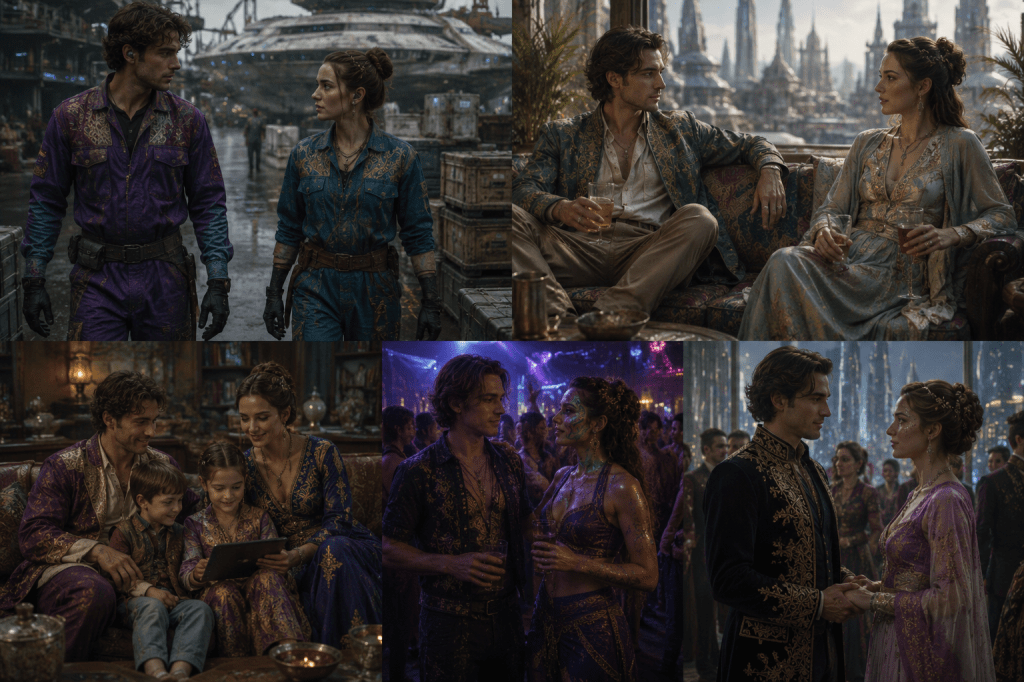
Fashion: Esperus view clothing and fashion as a high form of self expression. Males typically wear comfortable leggings, flowing shirts, and heavily embroidered jackets. Females prefer dresses and gowns that accent curves without being overly revealing. Clothing is colorful, and often patterned and embroidered. This is daily and formal wear. Workplace attire is more “mundane” in many careers, but while the common jumpsuit is a familiar sight in many Esperus worksites, even these get a splash of color and personal adornment.
Esperian females commonly wear their hair to mid back, often braided or done up in high fashion atop the head rather than allowed to flow free. Males commonly cut their hair at neck length. Tattoos are considered deviantly bizarre, but jewelry is popular. And while Tatoos are “bizarre” makeup in vibrant colors, even across the face, is a popular form of adornment, though….removable. Other cultures use makeup more modestly to accent facial features, Esperians use it as a temporary canvas.
Weapon Restrictions: Civilians may own and carry knives, and blades on their person. Single shot hunting rifles, shotguns and handguns may be owned and kept at home for self defense. Authorized psychics may be allowed to carry handguns for personal protection at all times. Veterans may own personal service weapons but must keep them at home. Hunting is permitted and any legally owned handgun may be taken to and from hunting grounds for sport. Restrictions are lessened in colonial environments where indigenous threats may exist.
Religious Practice: The three major religions in Esperus are the Church of the Mind, Church of Founders, and the Church of Galactic Consciousness. Individuals are free to indulge in the teachings and practices of any of these.
Work Culture: Esperus utilizes a seven day “work week” with three standard “shifts”. Most personnel work one shift, rest one shift, then sleep one shift for five consecutive days and then enjoy two days of rest and recreation. Psychic talents often only work three or four shifts per week, with an additional day devoted to psychic training and the remaining days for personal recreation. Individuals are often granted two weeks or more annually for vacation, though psychic talents typically receive double the allotment received by mundane colleagues in similar fields experience. Sick leave is granted as needed. Work contracts are typically for one year terms with regular renewals being at the discretion of the employer. Summary termination for violations and breach of contract is at the leisure of employer and can often be documented through psychic probes. Such actions are actually quite rare, but always a possibility and the fear of termination and possible blacklisting from future jobs helps ensure people do their jobs with proper diligence and devotion.
Entertainment: Esperus prize individuality and intellect. Board games, especially those requiring deep strategy, are very popular, as are games where predicting an opponent’s behavior and strategy, like gambling, are also very popular. In sport, individual competition is favored over team activities, with swimming, diving, racquetball and the like being most preferred, though some tandem sports, where two individuals must closely coordinate action and movement, are also intriguing as a psychic connection can greatly enhance performance.
“The Visitors”-Roughly every 100 years since Esperus was founded, there have been widespread reports of inhuman beings attempting to communicate with numerous individuals across the world through their dreams. Every time, there is usually some great scientific “leap” that follows. Following the “dreams” of 96 to 106, the pulse laser was introduced, ultimately replacing ballistic weapons on starcraft. From -5 to 5, visionaries on multiple worlds simultaneously imagined how to create the “warp drive”. Following the visitations from -105 to -115, nuclear fission replaced petroleum as the major power supply across Esperus, and according to historical records, on other human “homeworlds” as well. Earlier visitations led to advances that are corroborated in other histories as well. Esperus keeps this information confidential, as they are unsure what these “Visitors” intend, but they are clearly shepherding humans in some way for some as yet unknown purpose.
“The Conclave” While Treburne proposed and brought the other human powers together to form the Conclave, Esperus was the first to encourage Treburne to put forth the idea, but then withdrew from negotiations lest the representatives of other powers feel that Esperus was “nudging” approval and cooperation. Esperus rarely attends Conclave meetings in order to avoid being accused of manipulating thoughts and emotions, though it is their greatest hope that their fellow men are united as one when whatever the “visitors” are preparing mankind for comes to pass, for in numbers and unity, there is strength.
Treborn League: Human dominated nation with little interest in expansion except as a means to increase access to resources, perfectly content to trade with anyone and anything. Aliens are outsiders, but homeworlds are neither enculturated nor eradicated. Normally just…allowed to exist as potential non member trading partners
(Church of Enlightenment, Church of the Perpetual Soul, Church of Founders)
(Homeworld:
Treborn Alpha: Population 5 billion Industrial world, mixed settlement patterns (Use Korean names and Appearances)
Treborn Beta: Population 3 billion, Tech Research Node, mixed settlement pattern (Use Polynesian names and Samoan appearances)
League: Ruled by a corporate syndicate council, whose members are self appointed by mutual recognition, wealth and defacto power. Governs matters of trade, taxes, expansion and security (projecting military power is a weakness). Technically, there is also an Emperor and a Duke over each planet, but their powers are entirely ceremonial in nature. The original unifiers of Treborn Alpha and Beta’s successors ceded military control to commercial interests for the sake of peace and prosperity, eventually becoming mere figure heads
Marriage and Family: Treborn value family as the foundational element of society with many Treborn living in multigenerational households where a working age adult or couple live not only with their own children, but with one or both sets of parents, and occasionally with unmarried siblings as well. Parental respect and respect for prior generations is a primary value of society, and while individuals may seek out a spouse for love, actual marriage is arranged by the interested individual’s parents. Sometimes even long before a couple meet, though in such cases, arrangements planned by parents may be voided by the engaged parties without harm before a union is formally legalized, though often with a great deal of yelling and shouting by one or both individuals’ parents. Families are for creating children and carrying on the father’s family’s name, and the memory of the mother’s family. Same sex marriage is prohibited and viewed as devianlty pointless, though there is no criminal punishment associated with living with a same sex partner, just lots of guilt from one’s parents. Families are expected to raise their children in ther home , house them, and send them to state operated schools starting around age six and ending around age eighteen when the child is considered an adult. Adults often being looking for a suitable spouse around age fourteen, and then marriages are often arranged over the next few years, and then formalized between ages 18 and 22, with a first child being born within a couple of years after that. For an adult to remain unmarried past age 30 is considered an anomaly, and potentially embarrassing. For all of a parent’s children to remain unmarried and childless is considered a great insult to the parent as it represents the end of a lineage.
Housing: Housing is built to serve the individual household plus….guests! A married couple will have it’s own sleeping room, children may have individual or shared rooms, and there will inevitably be a guest room for at least one set of grandparents, and perhaps, if wealth and space allow, a second guest room for the other set of grandparents or the sibling of one of the married parties. While bedrooms are considered “private” in the sense that non family members are not expected to intrude there, if grandma moved in, she might just wander into the master bedroom whenever she feels like it outside of sleeping hours. Communal living and dining spaces that serve the entire household are used by non family guests, and while doors may have locks on them, most families share keys with kin who do not actually live within the house, so coming home from work, one is not surprised to see that a sibling who lives nearby has let themselves in because they want to visit in the evening. These design considerations are most easily met in single family detached structures, but even apartment units are designed for such purposes. There are domiciles built for single, unmarried persons as well, but generally they are small, inexpensive and thought of as “sad, temporary housing” for people assigned to remote work where family cannot come along, or as transitional spaces for young adults who have not yet married.
Diet: Humans, being omnivores, can eat a wide range of foods. Treborn eat a lot of ricelike grain in a natural, unprocessed form that is held together by thick sauces for ease of consumption using suitable dining utensils. This is supplemented by finely chopped meats and vegetables mixed in to these dished, and is often heavily seasoned. Terbron food is considered the most flavorful of all cuisines, though not as hearty and filling as Humanis dishes.
Education: Children are sent to state run schools starting around age six where they study reading, writing, mathematics, social history, business and economics for roughly six hours per day. After school, they typically spend a few hours with a grandparent or other family elder, learning family history and domestic skills. Beginning around age twelve, the standard four day per week school system shifts to a three day school week with the child accompanying a parent to work on the fourth day, provided that the work environment is “safe” for a child to be present and useful. Employers for hazardous professions will normally provide “simulation and safety” sites to teach job skills to the children of workers without exposing them to direct danger. Most children then grow up to follow in the profession of one of their parents, though over the course of study, a child may discover unique talents or interest that prompt them to pursue a different career. How well this is received depends on how far from home this career might take them and the personalities involved. While many cultures consider military service honorable, the Treborn tend to dread the potential loss of their children to foreign wars.
Medicine: Health care is provided by well respected private physicians. Employers will often assist their employees and their employee’s family members with paying for medical treatment, and if such aid is insufficient, one’s extended family will raise funds, call in favors and generally do anything necessary to help out. Family takes care of family, and for a family to have a physician among its kinship network is not merely a badge of honor, but a near certain guarantee of superior healthcare access!
Law: Laws against property theft and interpersonal violence are strictly enforced. Law enforcement is a primary function of the civilian government and cases are heard by a local panel of judges seated from among the oldest members of the community, with any kin to the parties involved excluded from a particular case. Capital punishment is enforced for crimes of rape and murder, but otherwise, punishment are restricted to financial fines, imprisonment, or in severe cases, banishment to a remote, high risk colony, alone without the support of family. Most consider this to be a fate worse than death.
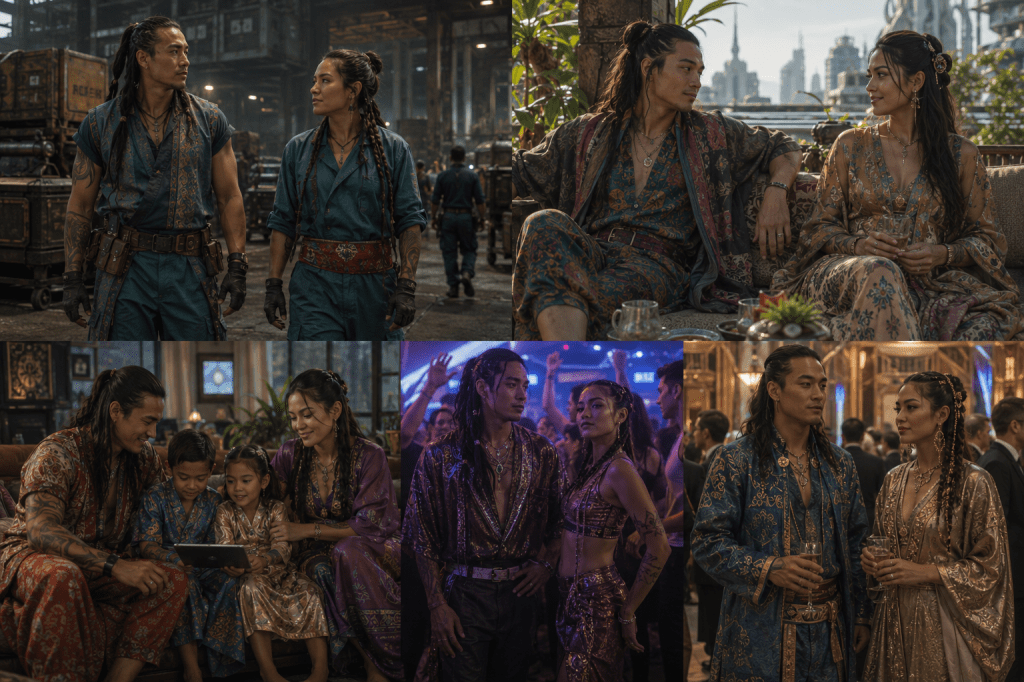
Fashion: While functional practicality may rule in the work place, with jump suites being common in hazardous professions, style is everything otherwise, and male and female fashion are instantly distinguishable. Males wear baggy pants and tunics, often with a belt around the waist, and snug overcoat for formal occasions. Women wear dresses or skirts with blouses and cuts that accentuate curves and sensuality. Clothing is colorful and often heavily embroidered or patterned to catch the eye. Family, fertility and nature themes are common in the art of many outfits.
Treborn females wear their hair as long as they can safely grow it, braiding it or tying it up as necessary for convenience and wearing ribbons and hair clips for adornment. Males often wear their hair down past the shoulders as well, with braids and ties for convenience and safety as needed. Rings, earrings, nose rings, bracelets are all desirable marks of wealth, station beauty and affection. Tattoos reflecting personal interests and family legacies in equal measure are common for both men and women, though the face is largely left clear of such markings. Daily make up use is for modest accents, but actual canvas treatments are common for special occasions
Weapon Restrictions: Civilians may own handguns, shotguns, single round rifles, knives and long blades. The latter may be carried in public for fashion or personal defense. Other weapons are for home security. Veterans may also own personal magazine fed rifles or even submachine guns, passing them down to their children. Likewise, these are restrict to home security purposes. Rifles and shotguns may be used for hunting as well. Restrictions are lessened in colonial environments where indigenous threats may exist.
Religious Practice: The three major religions in League space are the Church of Enlightenment, Church of the Perpetual Soul, Church of Founders as they are legally recognized schools of thought.
Work Culture: Businesses within the League are “family owned” and like to portray themselves as “one large extended family”, though that is often more a public relations effort than a true workplace attitude. However, since people tend to follow their parent’s profession, ownership and management is usually passed down from one generation to the next, and many generations may end up working for the same employer creating intergenerational loyalty and a true family feeling within many companies. Sometimes, the notion actually becomes reality. Following the customary human seven day work week, Treborn tend to take a “relaxed” view of work by other people’s standards. They follow the standard three shift daily schedule, but most Treborn only work four days per week, with the other three days spent with family for recreation and rejuvenation. In order to maintain production levels comparable to non-Treborn rivals, workforces tend to be larger than in other nations. The length of each shift varies by local custom but Treborn Alpha’s schedule is followed out of system. Work arrangements are voluntary by nature, but the expectation is that families work together and remain loyal to each other. For a person to quit a job where one’s parents worked embarrasses the parents, and for an employee to fire an employee may cause that person’s kin to quit or go on strike in protest if the action is considered unjust. Paid leave is typically offered at a rate of about two weeks per year for purely recreational purposes, though medical leave is issued as needed. Further family members can “fill in” for each other if one person needs time off, and a relative with the appropriate skills is willing to take the shift. It is of no matter to most employers as long as the work is done.
Entertainment: Treborn enjoy their family time. Board games, story telling and sharing music and celebratory dance are popular forms of entertainment. Most songs tell stories of the past, and every family has its own songs that recited family history. These songs are constantly being added to as each generation adds to the tales. Competitive individual sports are very popular as it allows families to encourage their members to show off their own prowess while everyone watches and cheers them on! Foot and swimming races are always popular, as are judged dance and diving competitions, singing contests and the like are favorites as well. More passive entertainment such as watching video programming at home as part of a household is also enjoyable, with programming being built around the notion that mixed age households will discuss the stories being told as they unfold. The pacing, with frequent silences after major scenes, strikes Federation viewers of Treborn programming as odd.
Merchant Ships from Treborn span known human systems, often far from home. These ships are generally crewed by close kin from one or two long affiliated families with a captains children, siblings, nieces nephews or cousins making up the bulk of the crew with a second family brought in alongside if needed. From a Pan Galactic or Humanis perspective, Treborn vessels are notoriously “over crewed”. If losses are incurred far from home, a local replacement may be hired to help get the vessel back home, but they are inevitably released from service once the ship returns to Treborn space and can pick up relatives of the remaining crew members. Outsiders stranded in Treborn space often have difficulty finding work without family connections and may have to wait until a foreign craft comes into port to hire back out. Experienced spacers either avoid joining Treborn crews as non relatives, or negotiate for high passage back home as part of the work contract.
The Conclave: Following the second PanGalactic War the Emperor of Treborn proposed the creation of a high council of human powers that would settle disputes, peacefully, thereby preventing future human on human bloodshed. He proposed a seven member high council made up of a single representative from each human homeworld, and a General Assembly made up of one representative from each member world of over one billion inhabitants. This was negotiated down to one billion “human” inhabitants, and a high council consisting of one representative per the four nations of Pan Galactic, Humanis Prime, Esperus Collective and Treborn League. The Voice of Esperus refused to join with an even number of members, and the Emperor of Treborn declined to be the Fifth seat to serve as tie breaker. So the separatists from Rimward Confederation were granted a seat in the High Council in spite of having a low population, no homeworld, and lacking a single world over one billion in population and thus no seat in the General Assembly.
Rimward Confederation: Human dominated nation forged from separatist worlds that rebelled from both Humanis Prime and The PanGalactic Federation during the second Pan Galactic world 50 years ago. Focus on trade and mutual cooperation with no desire to create or sustain a unified culture. More of a mutual defense pact than a true nation, only the military leadership seems to agree on anything, and that is non expansionist protection of member states. High corporate power.
(Church of the Perpetual Soul, Church of Founders, Church of Enlightenment)
(Homeworlds: None
Avarstan: Population 500 Million is the defacto “capital”, Industrial world (mixed population leaning towards heavy Humanis influences)
Kreigor: Population 250 Million is secondary
Confederation: A council led by one rep from each member world appoints a military commander to oversee defense, a judicial minister to settle internal trade disputes, but otherwise leaves other matters to local governors to direct.
Marriage and Family: The nuclear family is the normal household type. Individuals are encouraged to marry for love, raise children send them to school if available, teach them at home if it is not, and them at home. Children are highly valued by their families, but there are no governmental tax breaks or incentives. Same sex and interspecies marriage are not recognized, but unusual living relationships are not punished or prohibited. Most people have better things to worry about than other people’s private lives. Adults often marry shortly after establishing themselves as economically self sufficient. This typically takes place between ages 22 and 30. Marriage is often pledged for life, but serial monogamy is common as divorce is a recognized resolution to insurmountable personality conflicts within a household.
Housing: On most worlds, families (mother, father, minor children) live in small domiciles complete with all of the amenities required to support family, individual bedrooms for each child, a shared room for the adults, a kitchen, and a communal shared space for household members. These may be free standing “houses” on low population worlds, or apartment type structures in high population centers. These living spaces are considered “private” and while guests are often received in communal areas, sleeping areas are considered “intimate” and non-family members are not normally welcome there. Worlds with a humanis background often have “barracks” style housing for single persons, though over time, these are often torn down in favor of the Pan Gal private accommodations.
Diet: Humans, being omnivores, can eat a wide range of foods. Noodles, breads, fish, fowl and meat from a range of animals are all popular in Rimward quisine. Food is often heavily seasoned as flavors are mixed and new accents discovered.
Education: The Confederation operates communal schools to train its younger members, at least on older more heavily populated worlds. On low population worlds with smaller, remote communities, education is handled within the home through remote video instruction and parental guidance. Children from roughly age six years to eighteen, are expected to spend six to eight hours each days learning reading, writing, mathematics, history, political and hard sciences five days a week. After age eighteen, children are expected to enter a career, and after establishing themselves financially, establish their own homes. Often young adults will establish non marital households with members of their peer group until later deciding to marry either that peer or some other individual with whom they are compatible. Advanced University Education is not available within the Confederacy, though there are Humanis and Pan Galactic institutions that occasionally accept Confederation students who score high enough on admissions exams and can afford transportation, tuition and lodging. Careers are chosen by the individual based on personal talents, interest and the willingness of an employer to hire them. Family connections and personal references help a great deal.
Medicine: Health care is provided by private institutions and physicians are respected professionals. Availability of care depends not only on planetary resources and local tech, but also on the financial resources of individuals seeking care or the willingness of their employers, friends and family to contribute to covering costs.
Law: Laws against property theft and interpersonal violence are strictly enforced and protection extends to both humans and to recognized sapient non-humans who are legally within Rimward territory. Civilian law enforcement agencies are part of local governments, and a judiciary whose judges are appointed by the state hears all matters of criminal cases and civic contract disputes. Capital punishment is reserved for crimes of murder. Otherwise, financial penalties or imprisonment for fixed terms based on a schedule of crimes and appropriate punishments are the norm.
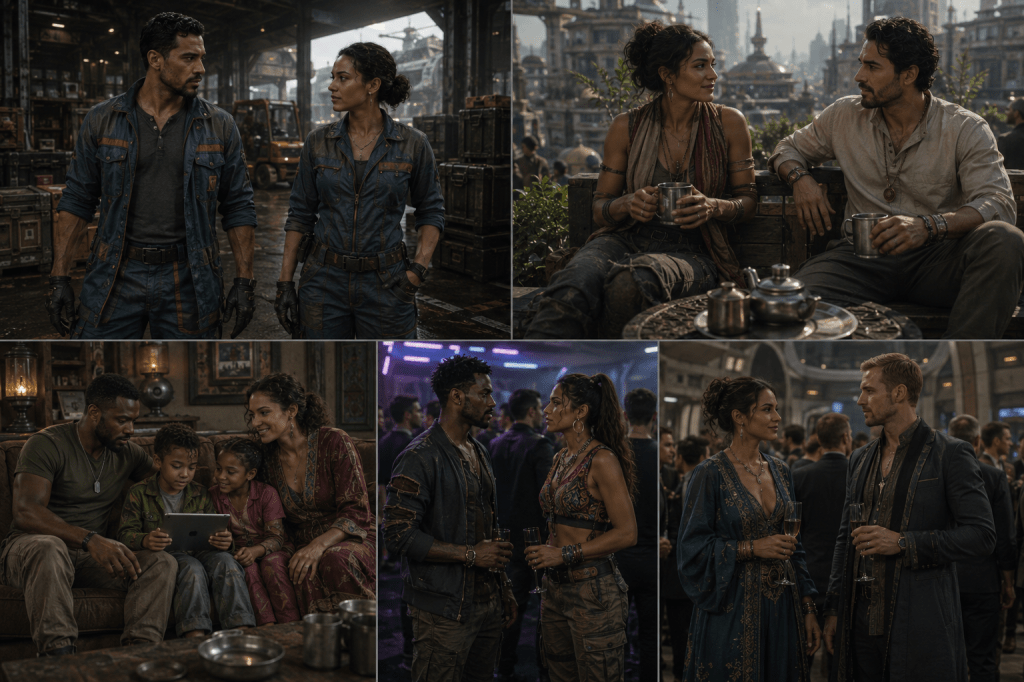
Fashion: Humans in the Rimward enjoy both Humanis and Pan Galactic fashions. Pseudo combat fatigue style clothing with close fitting undershirts are common daily wear. Jumpsuits are common work clothing. Snug leggings and a tunic or dress are considered “fancy wear”. Colors tend to be brighter than Humanis patterns, but not so bold as Pan Galactic prefers. Ease of movement and functionality are high priorities
Rimwarders mix both Pan Galactic and Humanis traditions, as usual. Hair is grown natural by men and women as is Pan Galactic custom, though military styles aren’t seen as unusual. Jewelry use is modest, but common. Tattoos are either unit related or reflect personal interests, but are concealable and relatively uncommon. Make up use is for modest accents
Weapon Restrictions: Civilians may openly carry handguns, knives, and blades in most environments, and keep shotguns and single shot rifles in their vehicles. Magazine fed rifles and submachine guns may be privately owned and kept at home for security against indigenous threats or human criminals.
Religious Practice: The three major religions in the Confederation are the Church of the Perpetual Soul, Church of Founders, Church of Enlightenment but most people don’t care who worships what as long as they mind their own business.
Work Culture: The Confederation uses a seven day week and a five day “work week” with three standard shifts. Most people will work five for six standard shifts per week, each on a different, usually consecutive days, and then have one or two full days off work for family, entertainment, worship or other personal reasons. The length of a shift varies based on arrangement with ones employer and agreed upon wages and hours. Most employers also grant longer leave periods and allow time off for illness with a certain maximum number of days that varies according to an employees skills and tenure as part of an employment contract. Employment is arranged by contract for a predetermined period of time. Breach of contract either by neglect of duties, sudden resignation, or sudden termination by the employer typically damages the worker’s reputation more than the employers and may result in an employee being unable to easily find future work. Employers rarely suffer from suddenly terminating an employee, as other people are usually eager for a decent job.
Entertainment: Confederation members thrive on physical entertainment. Competitive team and individual physical sports are very popular with many having “football” teams that compete against those of other communities with a level of physical contact that is often shocking to Pan Galactic observers. Non lethal combat sports are also enjoyed. Competitions of a physical nature are restricted to “like” adversaries: Male vs Male human, Female vs Female human, Hydrissian vs Hydrissian (for who can tell male and female apart). Music and dance are popular forms of entertainment, especially high energy forms of expression that leave listeners shaking their heads in rhythm or dancers covered in sweat, and perhaps a few bruises.
Separatists: The Rimward Confederation was formed by a handful of Humanis and Pan Galactic worlds rebelling against the warfare between the two powers, supported by local fleet commanders who backed the planetary governors with force of arms. Though initially confused by the sudden “freedom” Humanis settlers in the region largely adopted Pan Galactic views styles of housing, and views on personal freedom, while Pan Galactic residents embraced some of the more physical aspects of Humanis culture and broadened their culinary pallete. Many residents still hew to the old ways, but a new identity is slowly forming.
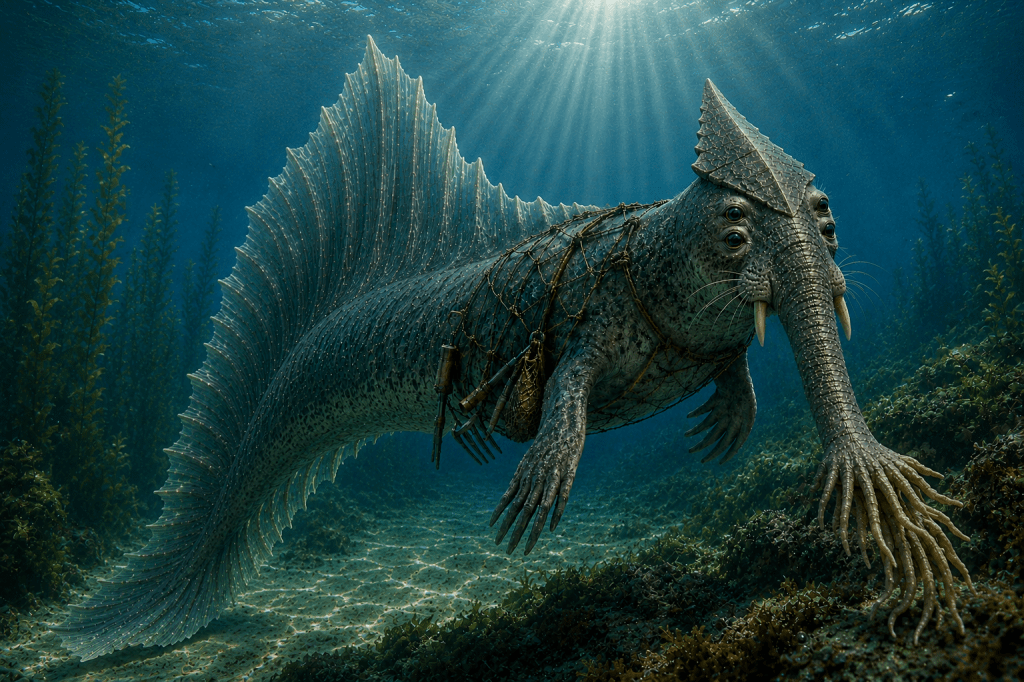
Platian Selkies- Aare an aquatic species indigenous to the planet “Platos”, as Pan Galactic explorers have named it.
Platos is a rather large planet, known for its impressive, but hard to extract without native assistance, iron deposits. The primary difficulty in mining stems from the simple fact that almost the entire world is covered in liquid water dotted by small, volcanic islands, with the remainder of the world being covered in ice. Median ocean depth is less than two hundred feet, but there are large regions far deeper than this. Underwater mining requires different techniques than those commonly used on terrestrial environments, and given the rate at which water corrodes iron ore, speedy extraction of a newly discovered vein is a critical factor. The second major difficulty is that it possesses higher gravity than most human worlds due to its large size and its dense mineral composition. Frequent volcanic activity constantly brings new material to the ocean floor, but working near such activity is a risky prospect. Fortunately, the abundant supply of potable water, a breathable atmosphere, abundant (and edible) sea life, and rich mineral deposits (though sometimes hard to access) have made it a planet of tremendous interest.
The native species, most commonly referred to as Selkies, is actually fairly advanced. In spite of living an aquatic environment, they developed metallurgy (using natural volcanic vents, and gathered phosphorous as a heating source rather than conventional fire) centuries ago, and compelled by natural curiosity to explore what dry land is present on the planet, the Selkies crafted hostile environment suits that resist not only the corrosive effects of submersion in water, but also provide life support and mobility for sea creatures desiring to walk about on dry land. Such native constructed devices are powered by chemical fuels and rely upon fluid filled tubes whose pressure levels can be manipulated mechanically, rather than by the electrical circuitry that comparable human equipment normally uses.
Flight is a new concept to them, introduced by human colonists, but Selkies seem to have an innate talent for it when control devices have been modified for their use. This is not surprising given that their aquatic home requires greater 3-dimensional awareness than humans are accustomed to.
Physically, the resemble seals, but with many significant differences. They have a single “tusk” like bone formation at the front of their head, the size and shape of which are a primary determinant of “beauty” in the eyes of most Selkies. This tusk is used as a trowel by farmers and hunters, and butting each other with a tusk is a common method of resolving heated arguments. Behind this tusk, four eye nobs protrude from the side of the head. Two are set on top of the protrusions, and two are set below. Except that each nob contains a pair of eyes, some have compared this feature the eye sockets of a “Black Moor” goldfish. The eyes above are used for distance viewing and to keep watch out for natural predators (not that there are many that would approach a Selkie settlement), while those below observe the working of the “hand” and what is within reach of the mouth. Beneath the tusk are the “hand” and “mouth”. The hand is a long muscular appendage that is alternatively referred to as a trunk or tongue by human naturalists. At the end of this muscle, it splits into a number of fine tendrils about the width of human fingers, but just as boneless as the trunk itself. With these, the Selkie can grip and manipulate objects with tremendous dexterity. The mouth is located just behind the “hand” and it consists of three, large grinding plates, surrounded by a dozen of the fingerlike tendrils. The mouth can distend about eight inches from the body, and the trunk can extend about three feet out, or contract to within six inches…within the protective cover of the tusk. Using the “hand” and the mouth together, a Selkie can grip and manipulate objects with ease, and observe the work being done with its lower pairs of outset eyes.
Being fully aquatic, the creatures have gills, flippers (strong enough to pull the animal across open ground…slowly, though this must be exhausting work), and a long tail fin which is vertically oriented, like a fish, rather than horizontal, like a mammals. This tail can be curled up and wrapped over the body like a blanket, though maintaining such a position for prolonged periods is uncomfortable.
They have two sexes, male and female. They birth live young, usually one at a time around, after about a seven month gestation period, and young are raised communally with their peer group. (Most “pregnant” females in a community will give birth within a month of one another, so members of a peer group are very close in age). Childrearing and enculturation are tended, overall, by the eldest adults in a community with short duration assistance by other adults whose specialized skills or knowledge are needed. After seven years or so, peer groups are dispersed and their members are “apprenticed” to those trades in which the individual seems to possess some talent. At fourteen years, the youth is physically and sexually mature, after passing some rite of passage no naturalist has yet observed, becomes an adult. There is no indication that this rite has any measurable mortality rate and it is likely of a religious nature rather than a test of physical prowess.
Selkies do not appear to have family groups or recognize biological kinship. While the mother/child relationship is vaguely comprehensible, they have difficulty imagining husband, wife, uncle, cousin, and even grandparent (as the child is unaware of his mother, though the mother may remember the child). However, this “familial” relation is replaced by a “peer” identification, which the Selkies will equate to the “brothers/sisters” relationship described by human visitors…except that when mating occurs, it is usually within this peer group, and Selkie suggestions that brother/sister humans must obviously do the same have been the cause of much embarrassment to the naturalists explaining human family structure to them.
Selkies generally live in shallow waters and raise/harvest the equivalent of clams, mussel, sea cucumbers and other small animals. Vegetable matter is not a significant portion of their natural diet, though hard shelled nuts have been accepted as an interesting novelty food when imported from earth. Militarily, they are amateurs. After inventing “firearms” (chemical powered projectile weapons) and hunting most of their natural competitors to near extinction, they apparently abandoned and lost most of their need for such weapons. While occasionally a squabble between communities might be settled by “warfare”, this appears to be a rarity among the Selkies.
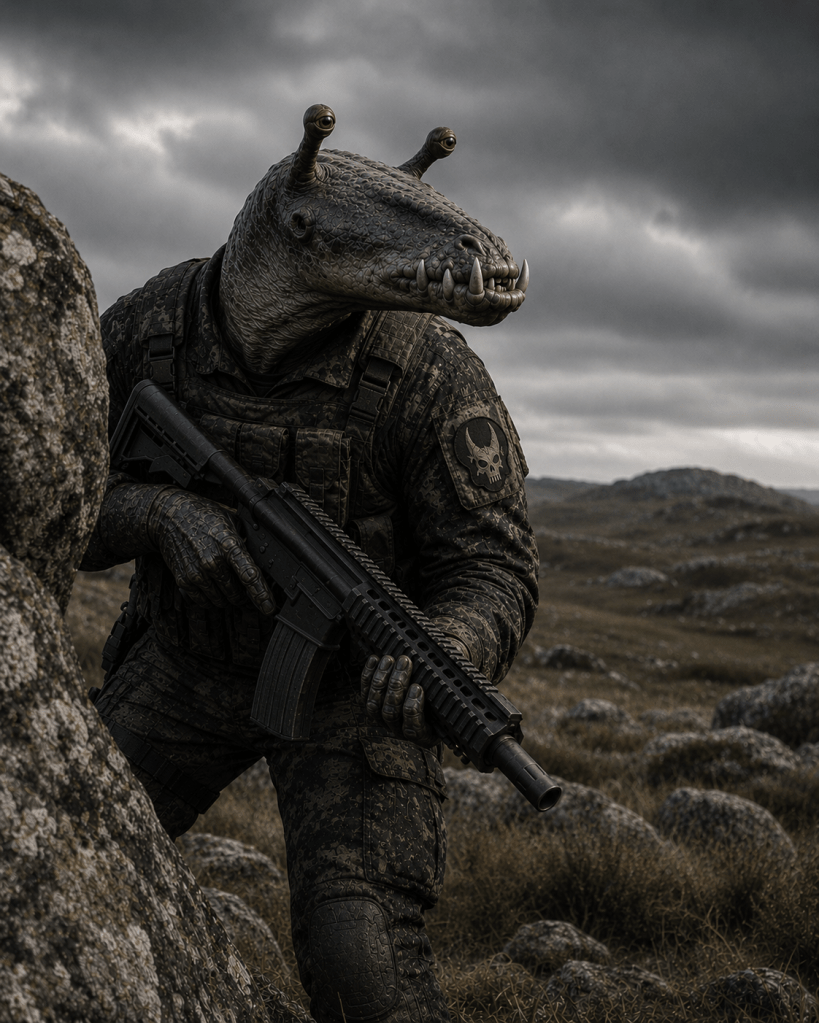
The Drantak
The Drantak are an omnivorous mammalian race comparable in size to humans, males standing about 2.3 meters tall on average, females roughly 1.8 meters tall. With two arms, two legs and no tails, their basic body shape is humanoid. They have three fingers and a poseable thumb, but their fingers are roughly twice the width of a humans. Feet have four toes, aligned in a similar manner to humans, but concealed, two each with a cloven hoof. Their faces are distinctly non human as well, two eyes, set out from the head on a short optical stalk with independent tracking. While 360 vision is technically possible, in practice, one eye will look one direction, the other in another, but depth perception suffers badly when eyes are looking in at different things. Their face is “snoutlike” with the jaw protruding about six to eight inches from the base of the neck, with sharp incisors, four canines on each side of the mouth, and wide molars. Their nostrils are wide and set flush against the flesh, but their olfactory senses are superior to humans. Ears are small and set back behind the ear near they juncture of skull and neck, and also independently mobile, shifting to better track individual sounds. Drantak are coated in a short layer of fur, barely a half inch thick, usually a monochromatic pattern. Those with piebald patterns are viewed as “odd” by others of the species. Communication is verbal and written, easily comprehensible to trained humans even if specific sounds are difficult to replicate.
Drantak evolved into the top tier predators of their homeworld. While capable of living on both on plants and animals, they developed a carnivorous bent over time as richer protein content improves fertility and the viability of their young, in addition to the benefit that hunting and consuming predatory rivals has for reducing threats and increasing the abundance of game. After establishing food chain dominance, Drantak continued to sustain a high protein diet though livestock breeding and management, though plant cultivation and consumption is a valuable secondary source of nutrition.
Drantak have two sexes, male and female, and even in without the height difference between male and female, the genitalia of nude specimens is easily recognizable by humans. While not genetically compatible, “recreational intercourse” between the two species is physically possible.
Drantak have live births, like most mammals, typically bearing one child at a time. Children are nursed by their mothers, growing steadily and becoming sexually mature around seventeen years of age. Natural life expectancy is close to seventy five years.
Drantak society is volatile, and “family” groups are temporary by human standards. Though technology has evolved, Drantak are still basically “pack like” in their thinking. A male will physically dominate and cow other males into submission, and females instinctively congregate around the most dominant males that will accept them under his “protection”. He sires their children and supports them economically, and the females strive to raise them and maintain the sires’ protection. But while in pre industrial ages, Domination involved brutal physical combat between males, now economic dominance, control of access to employment works just as well…not that physical brawls are uncommon.
Females will remain with a “dominant” male until a more dominant male becomes available to and willing to accept them and their children. Then they and any juvenile children he will accept join his “pack.”
This means that even the most dominant male cannot support a large number of mates and will often reject females with juveniles attached, as each additional mate strains the ability to support the others. Take too many and risk losing all!
Older, weaker males often die alone, regardless of how strong and successful they were in their prime.
With the temporary nature of “fatherhood”, Drantak form unusually strong attachments to their mothers. Juveniles and unmated males will will follow their mothers into new “packs” should she change sires. Juveniles expect to be supported, while young adults strive to contribute, their mother’s loyalty determining theirs! And while the new sire will favor his own offspring over those brought into the pack from outside, even the outside offspring add to his strength.
Males dominate decision making and risk taking in Drantak culture. Physically stronger than females, they are naturally expected to lead and provide, and they are driven to consistently prove themselves worthy of existing and potential mates. This drives them towards military conquest, financial risk taking, and a desire to always prove and improve themselves. Life is but one continuous test. Unmated males will attach themselves to their mother’s sire’s pack to serve them until such time as they can attract mates and form packs of their own.
Females focus on their offsprings. Seeking powerful males who can provide for and protect them. While females may learn trades, child rearing is their biological imperative, for children will always support their mother, and never abandon her. A female who rears multiple successful sons has many options when she outlives her own fertility as it is considered a great honor to have ones mother living as part of one’s pack as an adult.
Drantak art is musical, visual or performative, and comprehensible to humans even if the subject matter is not fully understood. It tends to glorify prowess and success. Warnings about “over reaching” are few and far between, as to reach for more is nearly ingrained into Drantak culture.
Drantak society is dominated by its warriors, not as a caste, but as individual leaders of fighting companies, starships and fleets. They are just as likely to fight each other as anyone else, constantly seeking to prove themselves and eager to take advantage of perceived weaknesses of their rivals. Drantak males are always testing each other, mentally and physically, seeking to intimidate others, and reassure themselves and their rivals of their place in the societal pecking order. Signs of weakness or uncertainty are quickly exploited and for this reason, peace missions are difficult with Drantak, for one who makes peace may be seen as weak by his followers. Generally, one has better luck approaching a warriors mother than the warrior himself as “protection of younger siblings by my mother’s request” is better received than “it is time to stop fighting”.
First Contact:
Pan Galactic vessels first detected Drantak starcraft near the world now called “Folly”, which was along the edge of Pan Galactic and Esperian space. Hoping for friendly relations, Pan Galactic vessels attempted peaceful communication and at first, things seemed promising. Trade and communication were established and there was peace for several years. Then…Drantak leadership realized that there were two different human powers in the region and neither was particularly strong, nor their worlds tightly held. By surprise attack, Drantak shut down interstellar commerce, crippled fleets and bombarded multiple systems into submission, asserting dominance over weakness and proviing the strength of a great many Drantak warriors before humanity could hit back. There are now many humans living as slaves under Drantak dominion.
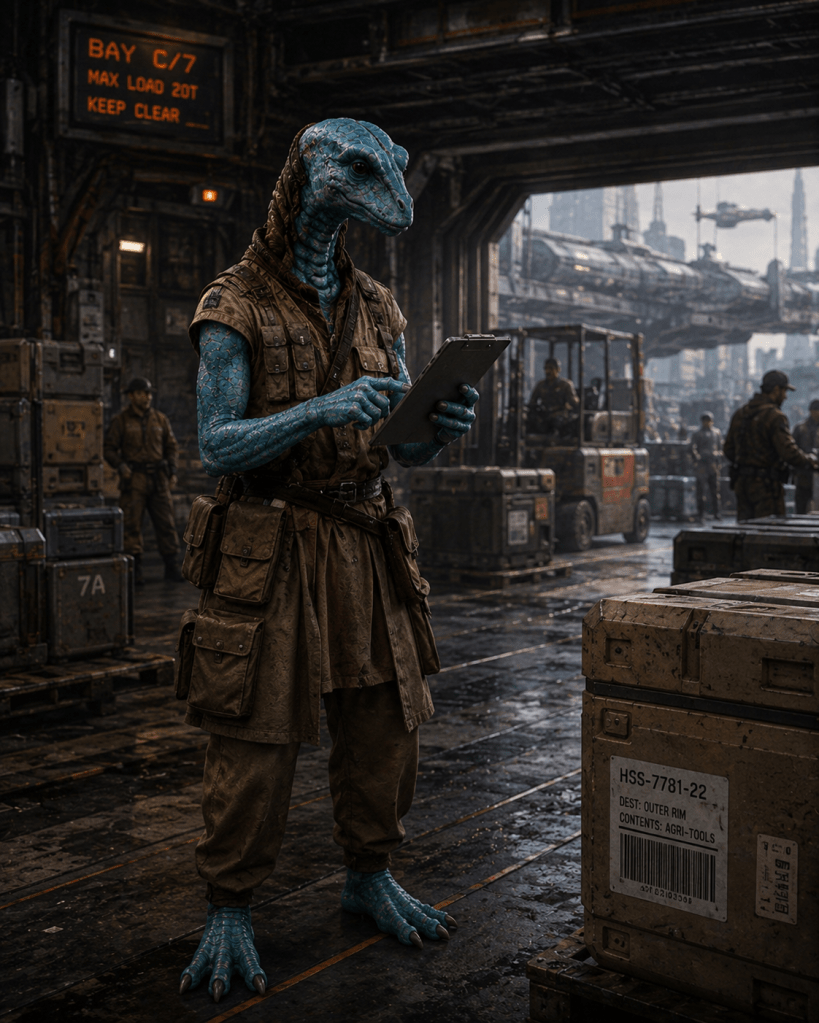
Hydrisian Protectorate
Hydrisians are a race whose first contact with humanity was marked by guarded curiosity between both species. Humanoid “reptilians” who stand between two and two hand a meters tall, depending on one’s measures, with two arms, two legs with a small head, a neck that is easily stretched or retracted based on the individual’s mood, habits and momentary need, roundish torso and snub tail. They have three fingers and an opposable thumb on each hand, and three front facing, one rear facing toe on each foot, with hooflike nails on each toe. Their flesh feels silky smooth to the touch, but is actually made up of tiny, mostly hexagonal, scales. It visually glistens but is dry to the touch. They have a pair of eyes situated on the side of their heads, with similar visual acuity to humans but a nearly 360 degree field of vision. Small nostrils which are less discerning than a humans, and ear membranes behind the base of the jaw with a similar auditory range to man’s. Adults have a “crest” along the back of their neck that grows larger over time and changes colors reflecting intense emotions of the individual. This crest contains hollow, longbones that are used to “whistle”. While Hydrissians vocalize and “talk” with their mouths, they “sing” though their crest, expressing a much wider range of meaning and feelings, augmenting their words with musical notes behind them.
Hydrissians evolved from a peaceful, highly intelligent herbivore species that found safety in numbers and environmental awareness, crafting tools for protection against faster, stronger natural predators, and ultimately developing agriculture, metallurgy and eventually space travel while eradicating or domesticating those creatures that threatened their ancestors.
Hydrissians have two sexes, male and female, and bear live young, one at a time. Males and females are physically indistinguishable to casual human observers as male genetilia is retractable, only emerging from a genital slit during mating. The female has a corresponding slit design to receive the male organ in face to face “intercourse.”
Young are fed by their parents who, when the child is young and helpless, regurgitate food from their forestomach into the child’s mouth much the way birds do. Hydrissians born to a mated pair will remain with their parents throughout their lives, resulting in ever growing family groups. There is no expectation that a mature adult will, or even should, leave home. Economic realities or curiosity are the primary causes of children leaving home. Other factors, like resource scarcity or the architectural limitations force a family group to break apart and while periods of “wandering” are not uncommon, family is forever!
Hydrissians form lifelong pair bonds based on personal desire and attraction, but due to their family structure and unity, these bonds are usually formed with siblings or cousins within the family group, usually between kin close to one another in age. The resulting “inbreeding” does not seem to cause the sort of genetic defects one sees when human populations engage in such practices over multiple generations. When a mate dies, the survivor does not take a new one, though some hydrissians exposed to human culture might be tempted to do so, it is considered a violation of the memory of the lost spouse.
Hydrissians have a natural lifespan around 100 years, and achieves sexual maturity around age twenty. Growth is continuous, in that there is no molting our shedding of skin, just a general slow maturation.
While culturally family oriented, Hydrissians are distinctive as individuals. Members of a family have personal names, talents and interests, and are in many ways, very “human like”. Experiencing love and devotion, raising children personally rather than collectively, and also perfecty capable of rage, anger, and fear as well. Even jealousy is a hydrissian emotion sometimes experienced when two compete for the same mate, though it fades quickly after a mated union is formed, for such unions cannot be broken. Infidelity and sexual promiscuity are horrible taboos, and casual acceptance of such practices by humans is grotesque to the Hydrissian mind.
Hydrissian art is visual or musical in nature, and often understandable, at least visually and audibly, by humans, even if the subject matter is obscure. Hydrissian technology is largely equivalent to human tech, and for this reason, trade is generally “peer to peer”.
–
First Contact: Hydrissians explorers from Bone Rattle discovered a Maran human colony on a world Humans call “Sophia”. Marans had already made contact with other humans from Sagitar and assumed that these strange spacecraft their sensors detected were another race of men. For their part, Hydrissians had previously documented other sentient species, notably the “Selkies” of Platas, and were curious as to human’s efforts to communicate.
Though there were linguistic difficulties, both peoples repeatedly attempted to hail each other, eventually finding mutual radio signals, and beginning some rudimentary translation before Hydrissian emissaries disembarked on a the human world. Goodwill and peaceful intent allowed some early trading, and eventually peaceful relations were established.
Second Contact: About seventy years after contact with Mara and Sagitar was established, half a dozen Hydrissian worlds were attacked by Human Prime warships. Hydrissia, though not a warlike race, had already encountered minor hostile alien populations and was able to mount an…ineffectual defense, and sent emissaries to Mara demanding an explanation of the sudden betrayal. Thus began the first Pan Galactic (or Humanis) War (depending one one’s point of view) as Pan Galactic mustered its fleets to defend their outgunned Hydrisian trading partners. A great many Hydrissian worlds were lost before peace was achieved, and many Hydrissians live under Humanis control as enslaved labor (though there have been efforts to transplant many back into Hydrissian or Pan Galactic territory).
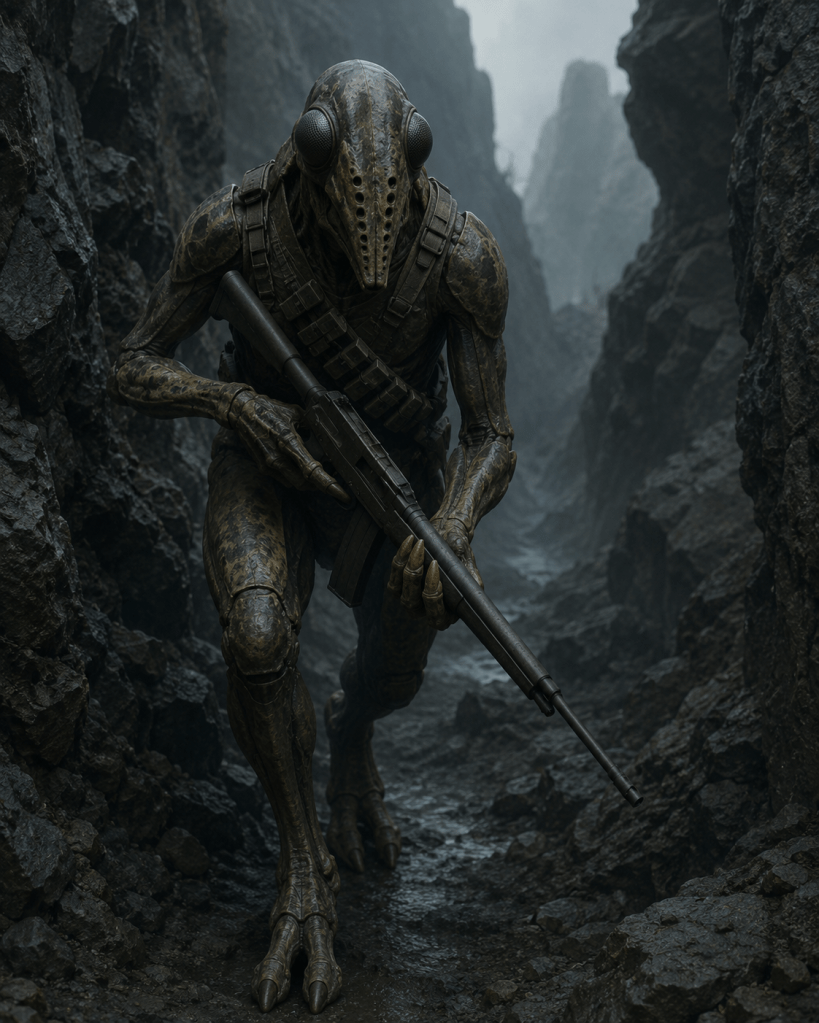
Spug Hiveworlds
Spugs are a race whose first contact with humanity was violent from the start. Humanoig “insects” standing roughly two meters tall with two arms, two legs, elongated heads and a stubby “tail”, they are distinctly inhuman in appearance. With a thick carapace and no externally visible sex organs, the race does not wear “clothing” as humans understand it, though harnesses, straps and holsters, often netlike in design, are occasionally used to convieniently carry and transport tools They have two large compound eyes set back halfway up their heads providing nearly 360 degree line of sight with a very short visual range compared to humans, though seeing quite bit more into the ultraviolet and infrared. Hands and feet each consist of two fingers and a thumb, thought the feet “toes” are not flexible enough for grasping and fine manipulation. Their “faces” are indistinctly bland to human eyes, no unique facial features that human eyes can normally detect. Examined under ultraviolet light, each spug has a nearly unique pattern of markings across the whole of their body allowing Spugs to easily recognize individuals. The center of the head, running down from between the eyes to the mouth, has a line of six paired nostrils, flat against the carapace. The “tail” possesses six pairs along either side as well, for eighteen pairs of nostrils on a healthy spug. The “mouth” consists of a retractable probiscus, which can extend to a distance of about ½ meter. This is a sharply pointed, hollow tube about 1 centemeter diameter on an adult which is used to pierce food, inject digestive acids and then suck partially digested food back into the Spug’s main stomach. Spugs have no ears, and do not “hear” in the conventional sense, but their sensitive footpads easily detect ground vibrations. Nor do they have vocal chords or the ability to speak, though they are not “silent” creatures. They can make sounds by clacking their fingers together, but that is not normal behavior as Spugs can’t hear such sounds. Stomping on the other hand, can sometimes be used to communicate “long” distances through earth when necessary.
Spugs communicate primarily through the release of pheromones, which are primarily produced though “sweat” glands located beneath the armpits and crotch area. Moods and even specific words and detailed information are relayed though sudden shifts in pheromone components, and sequence of scent release. Additionally, secretions from the probiscus sometimes add urgency or intimacy to a message. Communation by this means is “communal” by nature in that it is very hard to have a “private” conversation, thus groups of Spugs are privy to each other’s moods and messages in a way that humans may find incomprehensible and one with a keen nose can even pick up on recent conversations a fellow might have had.
Where wind, distance or physical separation interfere with communication, “thumping” the ground and communicating via vibration is also sometimes used for general warnings or calls for help. Some rudimentary physical sign language by hand gesture also exists, but usually if one is close enough to see a fellow spug, one simply uses pheromones if wind currents allow.
Spugs are naturally subterranean creatures, having evolved on a homeworld rich in biological material but with harsh surface weather. They are almost exclusively carnivorous, having evolved as apex predators in a world where other insectoid creatures feed on native undergound fungus growths. They have cultivated many species of “bug cattle” and have brought them across the starts with them, planting fungal farms, releasing the cattle to feed from it, then eating cattle as they always have. Spug held worlds are often rich in transplanted fungal growth and cattle, which is obvious from low orbit, but Spug settlements, being subterranean, were initially unnoticed by human explorers prior to first contact. Now humans are area of the indicators.
Spugs are a hermaphrodital egg laying species. When a colony possesses surplus food supplies that allow its members to “overeat” regularly, “spores” begin to form beneath the “tail” of its members. These spores are fertilized by other Spugs in response to a pheremonal “invitation” that prompts two spugs to eject a mistlike cloud of semen from their “tail” towards their partner, each fertilizing the other’s eggs. Self fertilization is technically possible, but roughly 90% of all spores are fertilized by another spug and self fertilized spores are rarely viable. Fertilized spores continue to grow and then detach when they reach roughly a three inch diameter, to be buried by those they fall from for safe keeping.
Spugs hatch as smaller versions of adults, and are tended to by others within their “hive”. Adults bring food to the nymphlings, tending to their needs as they grow, moult, grow and moult again until after a dozen years and twice as many moltings they become mature members of the community.
While living communally and sharing emotions and “secrets”, Spugs are individually self aware with unique interests and talents. While most Spugs are “farmers”, some develop a talent for trade, for fighting, for creating works of art (visual or olfactory pieces) or leadership.
Leaders are chosen by the willingness of others to follow them, which is often predicated by the strength of an individual’s scent glands as much as it is by any objective measure of intelligence. A stronger scent easily persuades the rest of a hive to change it’s moods and understand the “speaker”.
Spugs developed metallurgy much as humans did, and space travel as a response to population pressure at home. Spugs are eager colonists, though not intrinsically “hostile” ones, contrary to Humanis interpretation of Spug behavior.
Spugs have a natural life expectancy of about fifty years with sexual maturity achieved by age 12. This is often extended by colonies going “dormant” on occasion, when food supply an environmental conditions are poor. This has enabled Spugs to “seed” worlds, allowing their fungal farms and cattle populations to grow while colonists lay dormant for ten or twenty years, then awakening to plentiful food across the world. This has led to some first contact difficulties.
–
First Contact:
Humanis first encountered Spugs on the world now designated “SP 1101 (Hellion)” . Colonists landed on a world with a breathable air, sustainable climate, rich in gigantic edible fungus, but inhabited by large, very aggressive “giant insects”. The colonists soon took to killing these dangerous native fauna, unknowingly slaughtering Spug “Cattle”.
Spug colonists, dormant when humans first arrived, awoke to discover an unexpected invasive species on the surface of their new world slaughtering their livestock, and these aliens were either unable or unwilling to respond to scent or thumping, so Spugs took up arms to exterminate them.
Humans, set upon by subterranean aliens who, though armed and obviously intelligent, appeared unable and unwilling to speak, but quite willing to kill and suck the blood and internal organs from their victims, naturally fought back.
Reinforcing spacecraft arrived from both races, and the first Spug/Humanis war began. Eventually, Humanis decided that Spugs must be communicating telepathically, but later investigation by Esperus researchers dispelled that theory. Communication between the two races is still difficult, and mostly conducted via radio transmission and visual signaling.
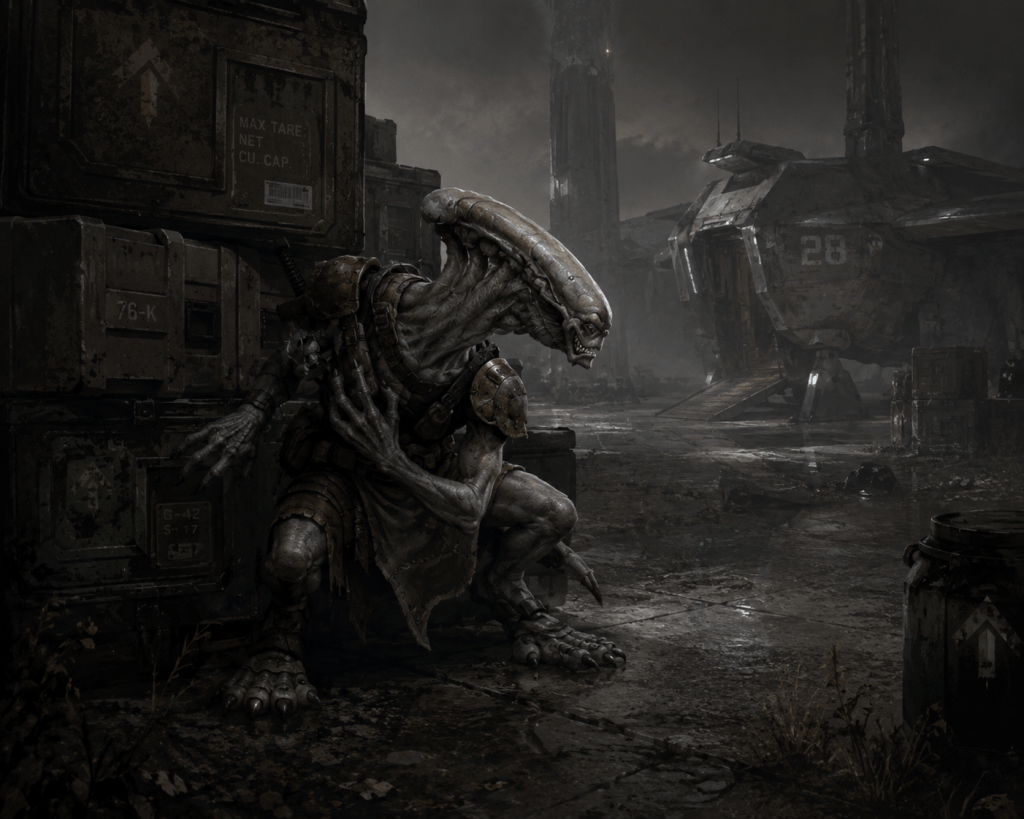
The Mephalians
The Mephalians are an omnivorous reptilian race visibly comparable in size to humans, apparently standing around 2 metres tall, but this is only due to the natural slouch of their walk that they usually lean their elongated heads and necks far in front of their body. Were a Mephalian to ever stand straight up with human posture, they would be closer to three meters tall. They have long, gangly arms and double kneed legs which make them powerful leapers. They have four fingers and an opposable thumb on each hand, five toes on each foot, and their hands and feet both look astonishingly human in appearance. Their necks are roughly half a meter long, and their head has a cranial lobe about the same length. They stand with their face (the front of the head) down below shoulder level. They have long pointed ears that are pressed tight against their cranial dome with unusually keen hearing, slit like noses at the front of their face with human like olfactory senses, and two tiny eyes with a short visual range and seemingly no ability to distinguish color. They have eight incisors top and lower jaw, a single pair of canines and long rows of molars, and a long, tongue that seems to possess olfactory sensors as well. They make a nearly continuous whistling noise through their nostrils which appears to be used for echo location, making up for their poor eyesight. Faces are “inhuman” to look at, but have individual distinctiveness sufficient enough to recognize specific individuals if one sees enough Mephalian to start to notice minor variances in features.
Mephalian seem to have evolved on a world with harsh climactic extremes as they seemt o be resistant to both excessive heat and cold and are believed to have come from a world inside the habitable zone of their home system, where it would be too warm to support human life, but perhaps living on the “dark” side of a world whose spin never resulted in a full day passing. They are known to consume both animal and plant products with little or no discernable advanct preparation, simply ripping flesh from bone from a living creature and eating it directly.
Mephalians appear to have two sexes but no visibly discernable external genetailia. Females seem to produce eggs within themselves which are then expelled and fertilized by nearby males after expulsion. Eggs are carefully collected into communal nursing areas, tended and kept safe from environmental threats and predators until they hatch)
Based on bone and tissue analysis, Mephalians have approximately a thirty year life expectancy, with sexual maturity and adult size reached after approximately five years. Eggs, after being laid, take about five years to mature and hatch.
Mephalians are, by nature, a nomadic hunting people that does not settle, build or inhabit areas for long. By the time eggs hatch, parents may be thousands of miles away, so Mephalians form “clutch” families that fend for themselves, hunting and learning as a group. Fortunately, Mephalians grow quickly and learn practical skills even faster. Mephalians are not “creative” in the sense of being able to visualize and imagine philosophical things, but they are very creative in figuring out cause and effect, and how things actually work.
Mephalian’s primary drive is merely to survive. Find food, shelter, eat and then find more food and shelter, so one can continue to eat and survive. Members of a clutch work together to accomplish this task, helping injured members, sharing food, working together to find safe places for the entire brood and to shelter the eggs that must inevitably be left behind.
Mephalians do possess language which is communicated by varying whistling patterns and humans can learn to understand those portions that are within the range of human hearing. They also appear to “sing” simply emitting sounds in rhythmic patterns to which all members of a clutch may sway back and forth with for no apparent purpose other than, perhaps, entertainment or relaxation. The sounds have been recorded by human researchers and are both eerily haunting and indecipherable as language.
Mephalians are a collaborative species. They do not compete with one another over food or mates. When eggs are laid, nearly every male present will attempt to fertilize them in an effort to ensure a clutch of eggs will hatch. There is no recognition of a “mate”, only “kin” within the clutch, and “our kind” on encountering another group. When two clutches meet, they will often examine each other closely, communicate briefly, sharing information, and then parting company in a way neither came from to find food and resources in some other direction yet to be recently exploited.
There does not seem to be any sort of leadership within a Mephalian group. Instead, when a decision must be made, there is a brief period of physical stillness accompanied by considerable whistling that seems to be some sort of debate and discussion of potential courses of action, then…the group seems to follow one course as though a vote was taken and a path agreed upon.
Mephalians do not seem capable of inventing space travel, or crafting advanced weaponry, yet they appeared at the edge of Treborn space, waged war for several years, then vanished back into the warp. The systems they seemed to hail from still possess Mephalian populations, but they seem primitive, lacking tools, equipment, cities, space craft, weapons. It is theorized that several Mephalian clutches “found” craft created by some earlier civilization, figured out how to operate it, and blundered into human space, then…moved on!
It is further theorized that Mephalians may be a designed slave race, or another people “seeded” into the galaxy by some founder civilization.
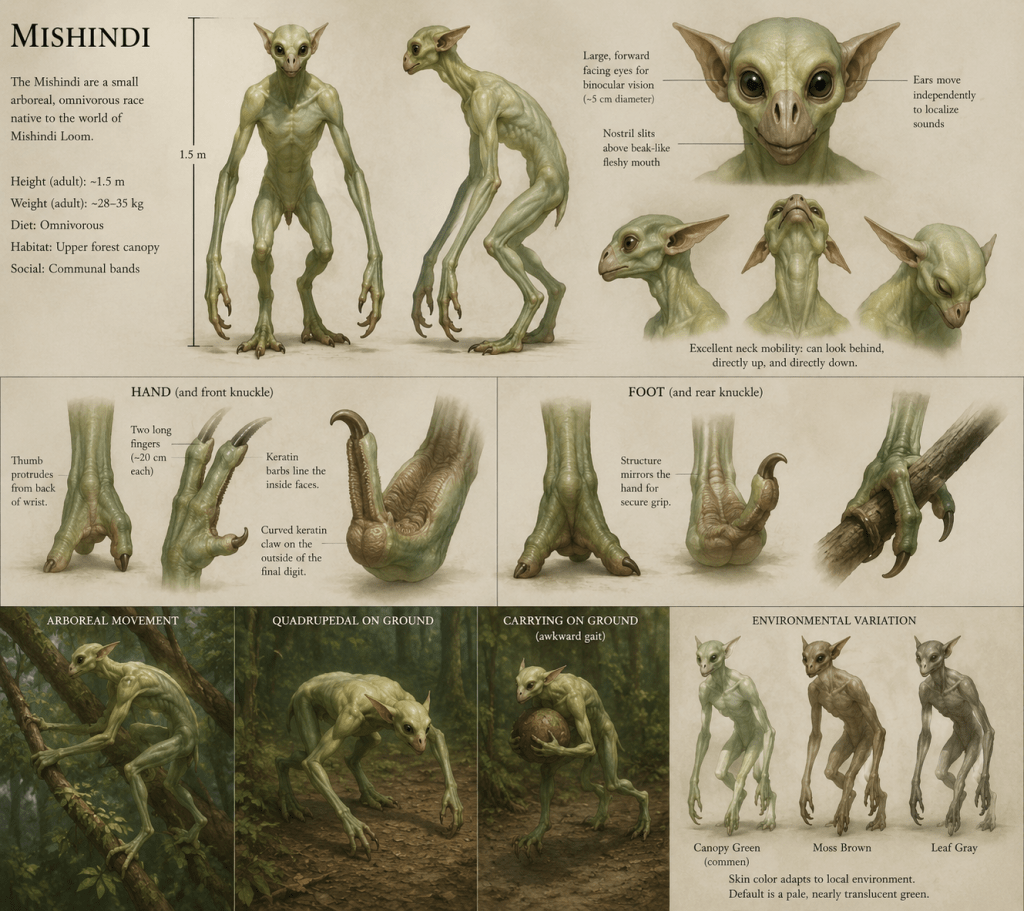
The Mishindi
The Mishindi are a small arboreal, omnivorous race. In their third and final stage, adults stand about 1.5 meters tall, but often seem smaller as they rarely stand fully erect. The creatures are bipedal, having two long gangly arms and two long legs. Their “hands and feet” each are consist of two 20 centimeter “fingers” and an equally long thumb that protrudes from the back of the “wrist” starting about three centimeters before the fingers so that appendage seems shorter than the two opposite it. These hands each have four digits, the last two of which have keratin barbs on the inside facing their opposite, and the final digit has a thick keratin “hook” or claw on the outside facing. Though not a delicate touch, these features ensure that whatever they grip will stay fully gripped until released from their hand. Being arboreal creatures, they use these hands to brachiate and easily climb through the thick upper canopy of Mishindi Loom’s vast forests. On the rare occasion when a Mishindi walks on the ground, they often walk on all fours, knuckling their hands so they may walk on their knuckles. If they wish to carry something on the ground, they will walk on their hind knuckles, but most Mishindi are not very good at this, and their gait is strange, awkward, and the ordinarily nimble and agile creature is likely to trip and fall a few times. In the trees, they easily carry things either in their foot claws or lashed to their bodies as they brachiate from one branch to another. These creatures have two eyes, forward facing for solid binocular vision, about five centimeters in diameter, sitting about a pair of nostril slits, which are located over a beak shaped, but fleshy mouth. They have large, pointed ears set back on the head that can move independently of each other and will often angle towards interesting sounds coming from either direction. They have slightly elongated necks with good range of motion and can actually turn their head to look directly behind themselves, directly up, and directely down between and behind their legs. Their flesh is bare of any sort of fur, feather or scales, and is soft and smooth to the touch. It’s coloration varies to match the local environment, but seems to default to a pale, nearly translucent green.
Penultimate stage, juvenile, Mishindi have the same basic shape as the adults, but are only about 1 meter tall with shortened trunks/torsos and legs, and a shortened neck. Their arms, hands and feet are “normal” adult size. They will slowly grow to about 1.25 meters before cocooning themselves for metamorphosis.
First stage, larval, Mishindi are have no arms, legs, or neck. They seem to be a wormlike trunk and head, the ears of which are flush with the body and much smaller in size than is normally proportional to the adult form. This stage also lacks a neck, with the head directly attached to the torso. It has six “fingers” on either side of the body that are used for locomotion, slowly crawling along treelimbs around which the fingers wrap. Newborns of this stage are approximately 20 centimeters long, and have vociferous appetites. They will grow rapidly to a length of approximately 50 centimeters before cocooning themselves for metamorphosis.
The First stage, larval, hatch directly from eggs, which are bout six centimeters in diameter and are housed by their parents in carefully protected nests, high up above the forest floor.
The Mishindi primarily eat fruit and nuts that grow in the upper reaches of the forest canopy, and huge numbers of insects that also feed on that supply. They also hunt and eat small predators that compete with them for these two food sources. They ferment and enjoy fruit based alcohol.
Mishindi have two sexes, though they are hard for the casual observer to visually distinguish as there is little sexual dimorphism. The males have retractable genitalia housed in a compartment that looks externally similar to the female’s. Mishindi mate at will, and lay their eggs in carefully constructed “nests” which are located within the most secure area of their homes.
Females are actively fertile only about one month per year, and while recreational sex is always an enjoyable family bonding activity, the tempo either slows or accelerates when one or more females in the household are fertile depending on the individuals and their desires. If the female and family desire offspring, she may be impregnated by one or more of the males as conception by one does not prevent simultaneous conception by another. A fertilized female will lay a clutch of three or four eggs about two months after conception, those eggs may have different genetic fathers. Females in threatened communities and underpopulated areas may lay eggs every year. In safe areas, a clutch every five years is normal. Eggs hatch after a month in the warm protection of their nest, then the offspring spend about two years in the larval stage, followed by a two week cocooned metamorphosis. Then the Mishindi spends about five years as a juvenile before cocooning for about two months as they transition to their adult form. Adulthood lasts from the sixth year to about age sixty at the highest end. Most Mishindi don’t live past age thirty-five unless their community is unusually numerous and proactive about dealing with predators. Maximum reported life expectancy seems to be around sixty years.
Mishindi are an intelligent, tool using, “civilized” species that is as capable as humans, but with different environmental and physiological constraints. They weave houses from treelimbs and leaves in the upper canopies, construct beds within them and insulated nests for their eggs and young, cocoon areas for metamorphosis They make bone and wooden tools, using their “hooks” to carve initial forms and sharpen them to suit. They make and wear “clothing” woven from vines and twigs. They aggressively hunt large arboreal predators, not for food, but for safety. They have both a written and a “spoken” language, which appears consists of whistles and clicks of varying tone and pattern. While the exteriors of their homes are covered in leaves to match the tree in which they are placed, the interiors are decorated with feathers, flowers and other ornamentation, along with hammocks for sleeping, stored food, nests for the young, extra clothing and tools. They do not craft metal or use fire, every tool and resource they produce can be found up in the canopy. Water is stores in sections of the surrounding trees where they have dug out “cisterns” to catch rainfall, and in times of drought, they will bore holes for tree sap instead of climbing down to find water.
The Mishindi live in small communities of twenty to as many as five hundred adults, depending on the abundance and variety of trees within a few miles of the community. They prefer larger groups for safety and…social engagement. As they go through three distinct life stages, the adults carefully protect their eggs and the first, “larval” stage, keeping eggs safely within their homes, and the larvae nearby under close communal watch. Second stage juveniles are allowed freedom to move throughout the entire community, but are quickly ushered home should they seek to leave the host trees. Adults freely venture many kilometers away, visiting other communities to trade or seek mates, but also to explore, hunt, and seek out new resources where their children might wish to live and raise families.
Mishindi are very communal creatures, and Mishindi families consist of a small number of males and females who construct a home and inhabit it together. Males within this group will freely mate with willing females within the group, then collectively protect and raise the offspring without regard to which particular coupling produced them. It is very rare for mating to take place between members of two different households.
Households are formed by invitation from existing members. New adult males of a community will work together in small groups to build their homes, accumulate goods and trophies, then visit nearby communities carrying “gifts” to new adult females within those communities. Females impressed by the gifts will follow the males back home, and if the the home impresses them, and there is room for them, they will join the household. Within six months of becoming an adult, young males and females will have built and established such families. Until then, they remain in their parents’ increasingly overcrowded home.
Mishindi clothing , woven from vines and other plant fiber, is designed for utility and is worn only be juveniles and adults. It is kept as minimal as possible, serving as lash points for tools that will be tied or hooked to the garment. This allows as much bare skin as possible to show for the sake of natural camouflage from the Mishind’s ever changing pigmentation.
Mshindi not only take care of their young at each life stage, but they also tend to their dead. Those who die up in the canopy are carefully carried many kilometers away and then lowered to the “realm of the dead” the forest floor, wrapped in woven blankets of leaves for initial concealment. A Mishindi who falls from the trees of their own accord, dying without warning, is mourned as one who is lost entirely. Occasionally, family members might try to recover the body for proper ceremonies, but often they are just left where they fall.
While sentient, and possessing language and writing, Mishindi’s intelligence varies by life stage. The larvae appear to have little understanding of language at all, and are essentially just eating machines whose parents take them to a food source, watch over them, and bring them back. As they larvae matures, they begin to recognize some of their parents words, and perhaps even start to respond to a name, but cannot communicate except for cries of hunger or distress. At the juvenile stage, language suddenly “clicks” inside the Mishindi’s head, and they become more fully self aware, establishing a name, habits and interests, emulating adult tool making and behavior to the extend their underdeveloped bodies allow. As adults, Mishindi possess the full range of communication and tool use described above.
The Mishindi do not have any sort of overarching government. Each household seems to lead its own life, gathering food, exploring, tending its young and building what it needs to survive. The communities are ad hoc, and designed for mutual protection, and while there are discussions about hunting threats, and occasional squabbles about overconsumption of food resources and the need to “drop” more seeds to the forest floor in one are or another to replace dead or dying vegetation, there does not seem to be any sort of ruler over a village, but more of consensus based governance. The adults will squabble and debate, then agree on a course of action.
Mishindi do occasionally wage war against nearby communities in times of great scarcity when food sources are depleted. This generally results in the weaker community relocating away from their stonger rivals.
Lassos, nets, bows and tethered, barbed arrows, and barbed spears with recall lines are the preferred home built weapons of the Mishindi, used primarily for hunting (so prey can be recovered from the line) but also for war.
Mishindi are curious by nature and have been intrigued by human activity on their world. Though, their presence has largely gone unnoticed, given that their tools are entirely organic and they do not use fire, they have largely gone unnoticed aside from a few reports from rural communities about alien treefolk. And this is all the better for the Mishindi as Humanis Prime settlers would likely have waged aggressive war against them. Occasionally, Mishindi will “steal” human tools left out by explorers in the night, but mostly, they just observe the ground dwelling “Star Demons” ground dwellers from above.
About 140 years ago, before humans came to Mishindi, Hydrisian explorers arrived and established contact with the Mishindi. Trade was established, exchanging Hydrissian weaponry and medical tools for Mulishindi art, alcohol and animal products. The Mishindi refer to Hydrissians as “The Sky Dead” for they come from the sky and walk the lands of the dead. When Humanis Prime expanded towards this system, Hydrissians warned the Mishindi of the “Star Demons” then withdrew their trading posts. Many Mishindi voluntarily settled on suitable Hydrissian worlds during this period of trade and continuous contact. It is not unheard of to find evidence of past Hydrissian presence in remote areas of Mishindi.
Hysdrissia estimates there may be close to 500 million Mishindi on the planet, and another 8 million scattered across forest worlds within the Hydrissian Protectorate.
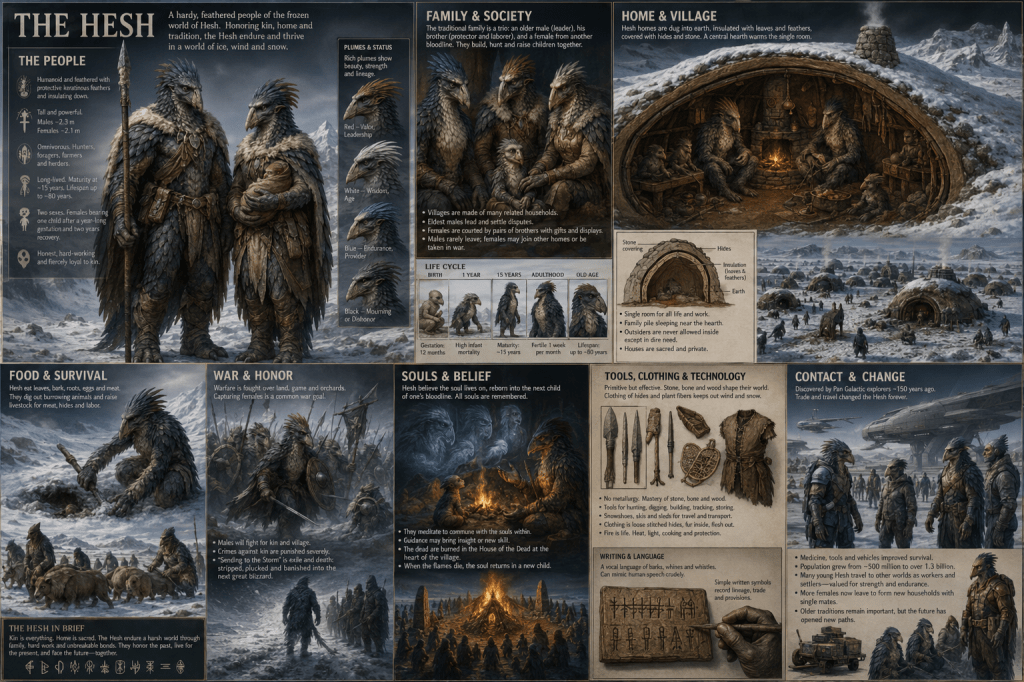
The Hesh
The Hesh are a humanoid sapient race of four limbed, omnivores native to the cold world of Hesh. Adult males stand approximately 2.3 meters tall, females about 2.1 meters. Their flesh protected by two layers of “feathers”, the inner is soft, and downy in texture, easily trapping air and capturing body heat. The outer feathers are smooth, sleek and scarcely flexible at all, often confused for splintered, chitinous scales if one does not recognize their origin. These exterior scales repel water and protect the tender flesh beneath from cuts and abrasions. On the head, some of these exterior feathers form great plumes whose color and texture vary and are viewed as signs of beauty or ugliness. Their flesh is mostly soft, tender, and sits on a thick layer of insulating body fat. The creatures have long noses, and their nostrils are wide, but not easily visible with a flap of feathered skin that drapes over them unless the creature is unusually winded or breathing hard. Their mouths are beak shaped, with a long jaw and overbite. They are technically toothless, but the inside of the mouth has grinding and cutting ridges that are actually modified feathers, which wear away, are spat out when they break, and quickly regrow. The creatures have large, round eyes set back beneath a heavy brow ridge, placed close together for solid bunocular vision. The creature’s ears are short and tube like in shape, collapsed against the side of the neck most of the time, but drawn tight against the flesh and opened wide when the creature is worried or alert. Their forelimbs, or arms, and about as long as their torsos and they have three fingers and a poseable thumb on their hands. The fingers are thick and wide, I’ll suited for delicate work, and the outside is coated in small hard feather “claws” while the inside has tough, leather skin much harder than most of the creature’s flesh and seemingly lacking in neural receptors. Legs are of similar length to the arms, but on the feet, all three digits align.
The Hesh are omnivores and live on a world where much of the ground is covered in snow most of the time. They eat leaves and bark from the ice adapted plant life, and traditionally used their hands to dig out animals that burrowed into snowdrifts or earth for shelter. Over generations, Hesh developed agriculture and specifically cultivated preferred plant varieties, and started raising livestock for meat and hides.
Hesh have two sexes and live birth their young. The males are visibly larger than the female and have broader frames. Male and female have easily easily identifiable genitalia, normally concealed beneath feathers except during mating, but obvious in rut. Hesh also normally wear clothing made from animal hide and plant fibers, the invention of which greatly expanded their range on their homeworld and increases storm survivability. Hesh mate at will, with females having a monthly fertility cycle.
Females are actively fertile about one week per month with single child conception followed by a full year of gestation during which time the female often becomes lethargic and loses significant body fat unless very well fed by her mate. After birth, it typically takes the female approximately two years to physically recover and her fertility cycle to restart. Most Hesh infants die within the first year under normal climactic conditions, though civilization has dramatically increased survivability. Female young, being smaller, and less fatty than males, tend to be more vulnerable to the cold, leading to a natural gender imbalance that vanishes in warm climes and civilized conditions. Hesh grow steadily and reach sexual maturity after about fifteen years, and civilized Hesh may live as long as eighty. Primitives, who live solely by hunting and gathering, rarely live past thirty-five.
Hesh live in small family groups that traditionally consist of a single adult female and a pair of adult male siblings. The older male is the head of the household and his brother a secondary guardian and laborer. The female is from another bloodline and is courted by males as a team, each seeking to prove their value as providers and protectors through gifts, and showing off their shared home. Several family groups will live in close proximity, forming villages of thirty to as many as a thousand households tending land, cultivating orchards for several kilometers around. These larger communities often trace lineage to a single family and regard themselves as kin. While females from other settlements may join the community, males only leave if the land can no longer support another household, then a dozen or more young males will establish a new settlement and attempt to attract females to them. Large settlements are generally led by the eldest male within who settles property disputes or other disagreements.
Warfare over access to good hunting grounds or control over productive orchards is relatively common, and the capture of females in warfare is often a secondary objective and often the only way a brotherless male can obtain a mate, who is often held captive until she resigns herself to her fate as his wife (usually during the first pregnancy).
A Hesh house is traditionally dug into the earth and carefully insulated with leaves and feathers. Sealed with a wooden door, and served by a central hearth fire that vents up through a stone chimney. The insulation is protected from stray sparks by a covering of animal hides then protected by a layer of stones on the floor around the hearth. The stones capture heat, and even if the fire dies, the home remains warm for several hours more protected from the elements due to the thick insulation and the heat radiating from baked stones. The home consists of a single room used for cooking, sleeping and labor, where children bear witness to their parent’s affections as there is little sense of modesty or privacy within the home. Hesh usually sleep in a family pile next to the hearth, resting on warm bedding, further comforted by one another’s body heat.
Outsiders are rarely allowed within a home. Upon adulthood, a male Hesh will construct a home. If he has younger male siblings, they will help, and then available females will be shown the home in the hopes they will join the two brothers as mate. Brotherless males rarely attract mates. Trios of males rarely do either, the youngest of which will typically remainn in his father’s home unless an older sibling dies, then he will take on the younger role, moving into the deceased’s home. Likewise, unmarried adult females remain in their father’s home. Otherwise, Hesh interact with non family members, aside from their own parents or siblings, outside, only allowing a friend within the home under threat of dire storms or great duress and emergency. Homes are private spaces.
Hesh technology is primitive by human standards. While mastering fire and the crafting of stone and wooden tools, they did not discover metallurgy. They learned to stitch hides together with fur or feather inside to capture warmth, and flesh outside to repel water, but stitching is very loose by human standards and such garments are only worn outside, for clothing has no purpose within the home. Tools are designed to help with hunting, stripping bark from plants, digging, storing or carrying food, tracking seasons and telling time. In terms of transportation, snowshoes, skies and pulled sleds are as advanced as it gets. Watercraft are unheard of for lakes rarely thaw and immersion is often a quick death.
Hesh possess a verbal and written language and while their own tongue consists of deep throated barks, whines and nasal whistles, they can learn to crudely mimic human speech. Their writing is simple and focused on trade or lineage information, tallies of provisions to offer in trade to other communities and records of who lived, died and how they were kin. Literacy is widespread, taught at home, and every Hesh learns their bloodline by heart.
Hesh honor their kin and males will eagerly fight on behalf of their male kin, which can cause disputes between two villages to escalate dramatically as other related villages join in a conflict. Crimes of fratricide, abuse of one’s parents or offspring, are capital offenses, being punished by “sending to the storm” where the criminal is stripped of clothing, gear and his feather’s plucked and then banished from the village during the next great blizzard. Rarely are the condemned’s remains found. Other crimes, such as property theft from kin or rape of non kin, are punished less severely, by a beating or plucking of head plumes.
Hesh believe that upon death, one’s soul is reborn into the body of the next child of one’s bloodline to be born. If a child dies before having offspring, that is the death of a soul, otherwise, the soul lives on, and most Hesh know the names of every soul within them. In times of despair, Hesh will meditate and seek to commune with the souls within, seeking guidance and insight. Esperus researchers suspect this communion is often successful as Hesh will often seem to gain some sort of temporary insight into skills they previously did not possess. When a Hesh dies, it’s remains are burned inside the “house of the dead” which is at the heart of every Hesh village. His kin (often the entire settlement) will mourn until the flames burn out, then eagerly await his return in the next child of his bloodline.
Personality wise, Hesh tend to be honest, straight forward and accustomed to hard work. They value kin, and the sanctity and privacy of home. They tend not to form close friendships with non kin, but will do anything for family.
Hesh were discovered about 150 years ago by Pan Galactic explorers who saw in the primitive peoples an ideal labor force suitable to many cold worlds or arctic zones of temperate worlds. Establishing trade and communication, many young Hesh were willingly exported to distant planets where they are somewhat incorporated into Pan Gal society in much the same way Selkies fill an undersea niche. With the introduction of advanced medicines, superior vehicles, clothing and metal tools, the population of Hesh has boomed from an estimated 500 million on first contact to more than 1.3 billion with another billion estimated to be scattered across Pan Gal and Esperus planets. The plummeting infant mortality has led to a surplus of females, many of whom leave their homeworld and form non traditional households with a single male spouse instead of a male sibling pair. There are some reactionaries on Hesh who are disgusted by these cultural changes, but by and large, life post contact is seen as easier by the younger generations.
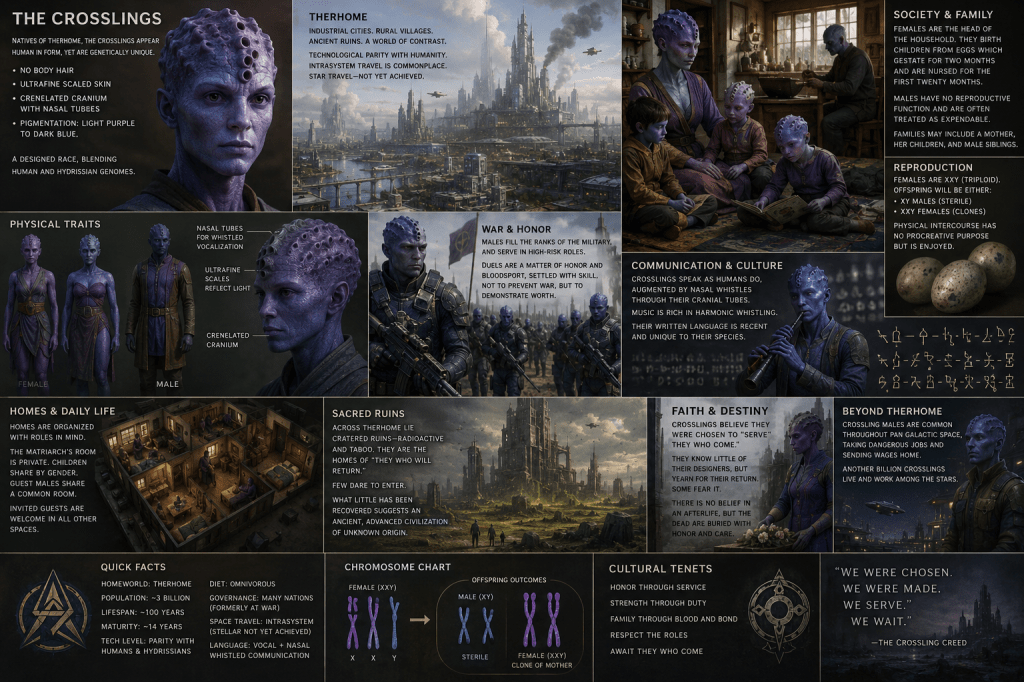
The Crosslings
The Crosslings, natives to the world they call “Therhome” look human, at least in dim light. Human like size and facial structure, human proportions, limb type and style.. the only easily discernable physical differences are the total lack of body hair, the bumpy, crenelated cranium riddled with hollow nasal tubes, that their skin is made up of ultrafine scales instead of flesh, and that their pigmentation ranges from light purple to dark blue. These similarities shocked Pan Cal explorers who first encountered them (and Hydrissian explorers as well, decades later). Further analysis suggests that genetically, Crosslings appear to be a designed species blending human and Hydrissian genomes. Some sort of “Founder” experiment of unknown success left behind when they withdrew or were destroyed.
Crosslings are an omnivorous race with technological parity with humans and Hydrissians, though they had not yet discovered star travel before first contact. Otherwise, agriculture, industry and urbanization patterns of their homeworld was less than a hundred years behind that of Sagitar and Mara with intra system space travel already becoming routine.
Crosslings, not surprisingly, have two sexes. Oddly though, the males have no functional reproductive purpose as the female replicates herself asexually. Bearing xxy triploid chromosomes, her offspring will either be born xy, and appear as sterile males, or as clones of their mother, bearing the xxy combination. Though physical intercourse seems to be treated as an enjoyable pastime, it has no procreative value, and interspecies breeding with either human or Hydrissian mates has never produced fertile offspring (and mostly, stillbirths, sterile eggs or nothing viable past the first month). Children are birthed from eggs, the female choosing, seemingly by will, to lay one. The egg gestates then hatches after a period of two months, then the newborn is nursed by the mother for the first twenty months until it can consume solid food. The child will grow to sexual maturity within fourteen years and natural life expectancy seems to be nearly one hundred years under normal circumstances. Culturally, males are almost treated as an expendable second class, and make up the bulk of the crossling military and are heavily employed in high risk occupations where females are culturally forbidden to serve. Consequently, it is unusual to encounter females off world or males in non military leadership positions.
A Crossling family consists of a mother, her minor children and perhaps some of her male siblings. The female is the head of her household and males are allowed to stay insomuch as they contribute to the home’s well being, assisting with childcare and providing labor. Many males live independently or alongside other males, and many females pair up, uniting and sharing child rearing and wage work to support themselves as a domestic unit. Such units are matters of convenience and female pairs often dissolve once children are old enough to take care of themselves.
While households are volatile and often short lived, Crosslings are not heartless and respect family bonds. Mothers tend to be very devoted and affectionate towards all of their children and siblings form bonds of affection that persist throughout their lives, but males and females have different roles to play, and males who live away from their sister often still provide financial support to her and her children with whatever surplus wages they earn.
Crosslings live in industrial cities, rural villages, isolated farms pursuing the usual range of settings and occupations with which humans are accustomed. Diet is similar. Homes are built in a style familiar to humans with separated sleeping and guest areas, whether in small apartments or detached dwellings. The matriarch will have her own room, children will share a room based on their gender, and guest adult males share another room. Only the matriarch’s room is considered a private space, invited guests are generally welcome elsewhere in the home.
Crosslings are unusually fratricidal in that the race may have been bred, at least in part, for war. PreContact, their homeworld had multiple nations which routinely fought over territory and over access to ancient ruins that dotted their planet. These wars were both brutal, and ritualized. Civilian populations were never targeted, and while firearms, aircraft and the like were widely utilized, many times duels would be demanded by officers of the 2arring factions, not as a means to resolve a conflict with less loss of life, but to demonstrate personal prowess in hand to hand combat during a break in operations. Post Contact, internal warfare has ceased, but dueling persists as a recognized form of bloodsport.
Crosslings speak using the same vocalizations as humans, augmented by nasal whistles through their cranial vents to express emotion or secondary messages. This added vocolation option features heavily in crossling music. Their written tongue seems to be a recent innovation that matches nothing the has been found on the ruins on their homeworld.
Crosslings speak of being a chosen race, selected from among all others to “Serve they who come”. When pressed, it is clear that they know little about they who will come other than that they are credited with having designed the universe to suit their needs and the Crosslings to serve them in some way. Most Crosslings yearn for “they” to arrive, though some, having encountered human reaper theories, fear that day. They generally do not believe in an afterlife, but bury their dead to help mourn, and protect community hygiene.
The crossling homeworld is dotted with cratered ruins that are radioactive dead zones. Though religiously valued to the Crosslings as the homes of they who will return, these sacred spaces are taboo, and rarely explored. What little that has been recovered seems proof of an advanced species of unknown capability and intent. Fragments of writing have been recovered but no baseline to help translate has yet been found.
Crosslings can be cunning and devious, clever and cheerful, honest or kind. They express much the same range of emotions and goals as humans, but with a different understanding of family, gender roles and destiny. They have adapted quickly post contact and males are commonly found throughout Pan Galactic space, taking high risk jobs and sending wages home to sisters or mothers.
Therhom has a population of about 3 billion Crosslings. Another billion are likely scattered across Pan Galactic space.
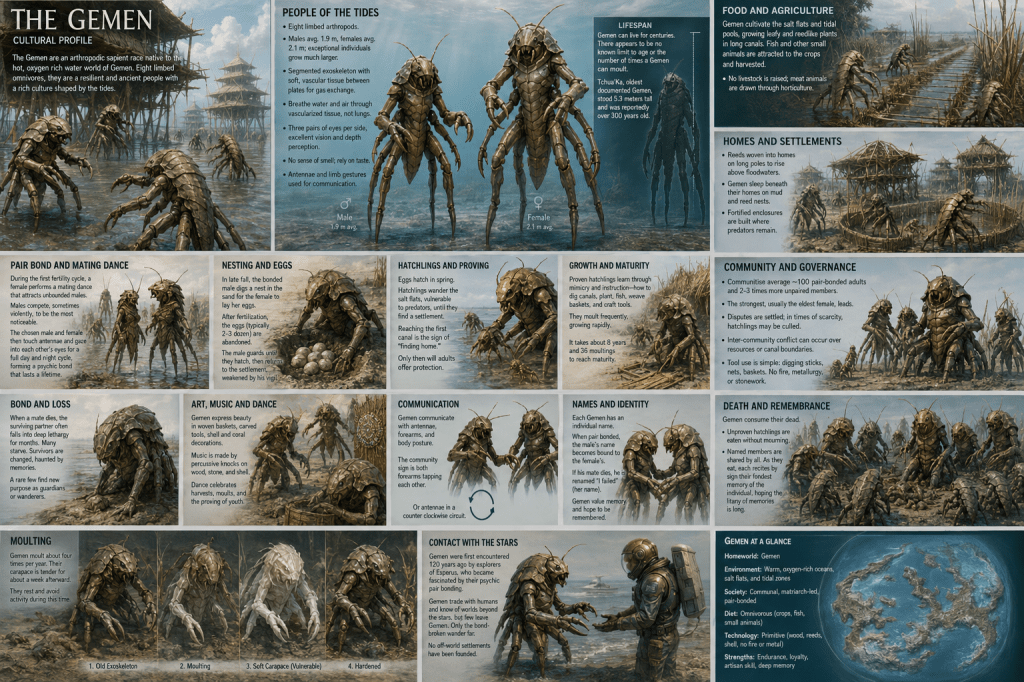
The Gemen
The Gemen are an arthropodic sapient race of eight limbed omnivores native to the hot, oxygen rich water world of Gemen. Adult males stand approximately 1.9 meters tall, females approximately 2.1 meters tall on average, though much taller individuals exist, the eldest documented of which was a female named Tchua’Ka who stood approximately 5.3 meters tall and was allegedly over three hundred years old. There does not seem to be a limit on how many times a Gemen can moult or how long it might live. Gemen possess a segmented, armored exoskeleton that protects their back, underbelly, head and limbs, but soft tissue is visible between back and under elly and beneath the neck. This soft tissue is riddled with blood vessels that draw oxygen directly from water or the atmosphere rather than relying on lungs like most creatures. The Gemen have eight limbs. The rearmost two pairs of limbs are used for walking, they are segmented with spike like ends rather than feet. While perfectly suited to walking in sand or mud, these have difficulty finding natural purchase on stone or pavement. The two pairs of forearms each end in pincer like manipulative appendages. The upper pair are larger and stronger than the lower pair, but matching in “hand” design. Each hand has three single joint fingers angled towards each other in a triangular arrangement and a Gemen must typically use two hands to emulate the dexterity of a single human hand. They have a short, armored, hooded neck their heads can draw back into for protection. They have double mandibles set within each other. The outer pair is for tearing, cutting and helping hold food in place while the inner pair is for chewing. They have three pairs of eyes, round and black, set in triangular formation on either side of the head, the foremost of each set have overlapping fields of vision, granting binocular vision and solid forward depth perception. The other eyes from each pair work together to offer a solid side view and depth perception and monocular rear view. They possess a hearing membrane at the base of the neck, but when frightened, and the head is withdrawn beneath its armored hood, they become nearly deaf. They have no sense of smell, but rely upon taste to detect food spoilage. They have a pair of antenna, with along with their forearms and body posture are used for long distance or silent communication. They shed their skins by moulting about four times per year under normal conditions, and their carapace is unusually tender for a week afterwards. Gemen do little other than rest during such times.
Gemen are omnivores who cultivate the salt flats and tidal pools of their homeworld growing a variety of leafy and reedlike plants in long canals they have constructed, and harvesting the fish and other small animals drawn to those same crops. They do not raise livestock per session, but attract meat animals through horticultural practice.
Gemen have two sexes and form life long pair bonds. These are not “families” in the human sense, in that Gemen do not raise their young in any sort of parent child relationship, but they do pair up as adults to form a procreative union. Gemen females, during their first fertility cycle, will begin a mating dance which attracts unbounded males. The unbounded males will begin to dance in response, jostling for position to be the most noticeable competitor in the female’s line of sight. Sometimes, the competition gets violent and can be likened to a heavy metal mosh pit and injuries among competing males are not uncommon. The dance continues until all but one of the males give up from exhaustion or injury. Then the female approaches that chosen male, and they stare into each other’s eyes, antennae in contact, for a full day and night cycle. During which, Esperus researchers believe a psychic union is formed for afterwards the male always seems to intrinsically understand the needs and desires of the female even when no audible or visible means of communication are present. He becomes her protector and devoted himself to ensuring she never lacks for food and always delays moulting until after she has recovered from hers so he can protect her in her weakness.
Female Gemen are fertile in late fall and during that time, their bonded mate will dig a nest in the sand, often some distance from Gemen settlements, for her to deposit her eggs and he his semen. Once fertilized, the two or three dozen eggs are abandoned, the male stands guard nearby until the eggs hatch, then he abandons his post and returns to the settlement, often emaciated, and eats until he regains his strength following the long vigil. The eggs hatch in the spring and the young, unprotected hatchlings will wander the salt flats, preyed upon by local predators, until they stumble across a Gemen settlement. No adult will offer protection or guidance to the hatchlings until they have “found home”. But once hatchlings reach the first canal, nearby adults will drive off any predators.
A Gemen whose bond dies often falls into a deep lethargy for several months. Many starve to death during that time. Those who endure are shadows of their former selves, plagued by memories shared with their former mate and pitied by the community. A rare few find new purpose and become guardians of the settlement or wanderers. They are often respected, but viewed as strange.
The “proven” hatchlings are then incorporated into society, quickly learning language, how to dig canals, plant cuttings, harvest and fish. Through mimicry and occasional instruction, they learn to weave baskets and over the course of a year may moult as many as six times, rapidly growing in size. It takes about eight years and 36 moultings for a Gemen to reach physical and sexual maturity.
Gemen communities, the sign for which is each forearm tapping the other or an antennae in a counter clockwise circuit, typically number around a hundred pair bound adults with two or three times as many young or bond broken survivors living within. Farming and fishing are the way of life. Tool use is “primitive” by human standards as the Gemen mostly make digging sticks, nets, and baskets, having never developed fire or metallurgy. Even stone work is foreign to them.
Gemen construct houses of reeds set atop long poles to lift them up above floodwaters. Not that Gemen are averse to getting wet, they can breath underwater just fine, but they don’t want to lose stored food or carefully claw carved and crafted wooden tools to rot, or simply see valuables float away with a receding tide. They typically sleep in the shaded area beneath their homes, upon mud and reed nests, hidden from the sun and comforted by the waves. In areas where large predators have not been hunted to extinction, Gemen houses and sleeping nests are constructed within a fortified enclosure. Such defenses are rarely needed these days.
Gemen communities are “led” by the most physically powerful member of the community, typically the eldest female. Rarely done, she can drive out hatchlings or order them killed or eaten if the village has grown to the point where new canals cannot be dug or more food raised. Likewise, Gemen communities that grow to the point where canals start to intersect another’s may wage war, with the males slaughtering each other until one settlement is left open and it’s females vulnerable to attack. But generally, governance consists of settling disputes over food distribution in times of hardship or squabbles over who gets to keep some strange artifact that washes up on the shore.
Gemen value artistic expression, weaving baskets in beautiful patterns by varying reed selection, or even dying reeds, claw carving artistic motifs into wooden tools, and arranging shells and coral into patterns woven onto their homes. They enjoy music, made by percussive knocks against stone, wood and shell, but obviously not when frightened. And they dance, not just as part of the mating rites, but as celebration for harvests, moultings, and the proving of the next generation.
Gemen possess individual names, though once pair bonded, the male’s name becomes “bound to” the female’s name. If the female later dies, the male is renamed “I failed” female name. They have personalities and individual interests. They form friendships with one another, helping each other with their canal sections, possess personal property, tools and “jewelry” with which to adorn themselves. They share stories of past generations and community history and hope to be remembered by future generations. They do not possess writing of their own.
Gemen consume their dead as food. If hatchlings must be slaughtered, they are consumed as any other food might be, with no mourning or regret, for they were nameless and unproven. Once proven though, and named, a Gemen is part of the community, and flesh is shared by all members of the community as each recites by sign language, their fondest memory of the individual. Gemen hope that the litany of memories when they die is a long one.
Gemen were first encountered 120 years ago by Esperus explorers who became fascinated by their psychic pair bonding. While Gemen have learned to trade with humans and are aware of worlds beyond the stars, very few, mostly bond broken individuals, have left their homeworld. No off world settlements have yet been founded.
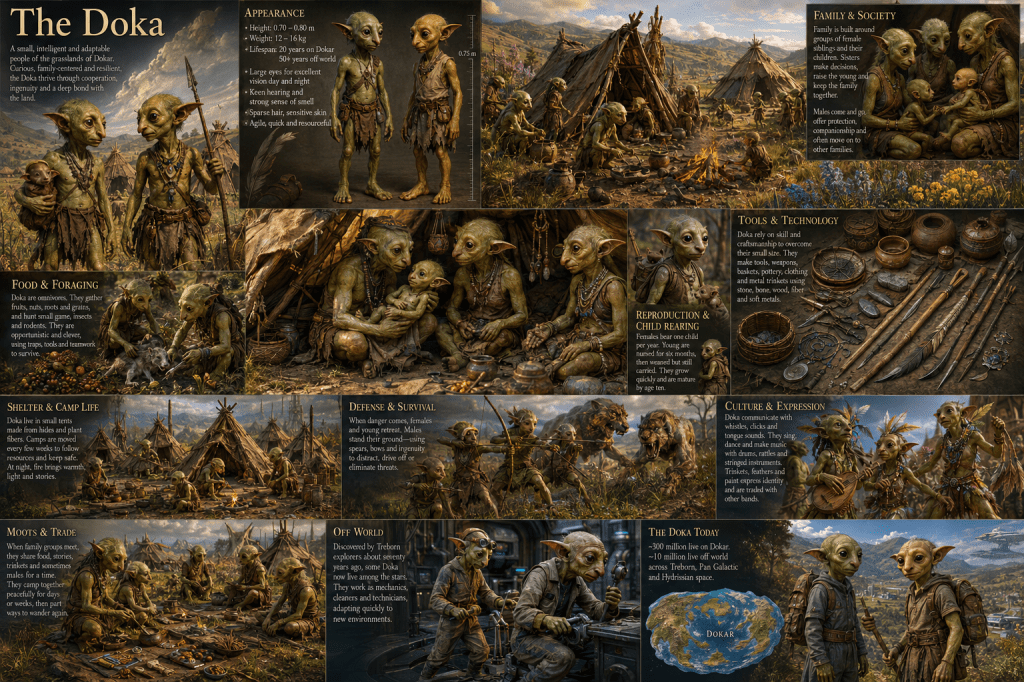
The Doka
The Doka are a small, humanoid race of bipedal omnivores native to the grasslands of the temperate garden world Dokar. Standing roughly 0.75 meters tall as adults, these diminutive sapient creatures have a humanoid shape, with five fingered hands, human like five toed feet, two arms, two legs and can easily don clothing designed for human children with very little adjustment, though they are much skinnier than a typical human child of similar size. They have sparse body hair, and rely upon clothing for protection from the elements. They possess two long, pointed ears set back on the sides of their heads and possess keen hearing. They have large, bulbous eyes set forward and protruding slightly from the skull for excellent binocular vision and superior peripheral vision. They possess relatively long noses, with paired nostrils, and a receding jaw with a mixture of cutting, stabbing and grinding teeth. Skin tones range from a natural forest green to a mustard yellow under continuous exposure to sunlight. They are mamalian, birthing live young and females nursing them. Physically, they look very much like malformed humans though there is no genetic kinship.
Doka are omnivores who eat wild fruits, nuts, grain and roots they harvest in their travels, as well as small insects and rodents. They can and will eat larger animals, but are not aggressive hunters as their size and technology make hunting dangerous. Instead, they are defensive and opportunistic killers, eating creatures they kill while protecting themselves, or those they can chase off a cliff, catch sleeping, etc.
Doka have two sexes and bear live children. Females will nurse the child for six months while it is helpless and unable to walk. Afterwards, it is weaned but often still carried. Doka grow rapidly and are physically and sexually mature by age ten. Life expectancy on their homeworld is about twenty years, but off world Doka, living among humans in more secure environments with steady food availability typically live to age fifty, and at least one past age 65. Females are fertile year round but typically only bear one child per year.
Doka live in small, extended family groups. Males scout, protect and guide the community, females carry supplies and the young from one camp to another, then everyone gathers edible vegetation and kills small game. When threatened, females and young retreat, while males attempt to distract, drive off or kill the predators. Communities often number in the dozens, organized around a group of female siblings, their mates and offspring, and rarely stay in one place for more than a few weeks before moving on to seek fresh gathering spots.
Female sibling groups are the core of the family structure, working closely together to help each other raise their young. The sisters collaborate and decide when it is time to move to new grounds and whether something is too dangerous to let live. They also decide when Young males should be sent to join another passing group and which makes to accept into their own.
Aside from the female siblings, family is a fluid concept. Males will come and go, attracted to groups of well fed and fertile females, and eager to be allowed the privilege of mating access. Males are then driven away in times of scarcity, or lured away by better offers, but while present, they are eager defenders of the sisters and their offspring, especially those young enough to possibly be theirs. Siblings do not mate with one another.
Doka make up for their small size and fragile structure through extensive tool use. They use fire hardened wood and stone digging tools, spears and bows. They craft clothing and tents of hides and plant fibers, baskets of reeds, clay pots and even construct trinkets from soft surface metals that can be melted and shaped in open flame.
Doka sleep in small tents where a sister and her children, along with a male or two, can find safety and warmth at night. Males may change tents from one night to another, but when no sister lets him share theirs, that is when he knows he has been cast out.
Doka have names and personal property, and communicate through whistles, and tongue sounds and can easily mimic human languages. Doka clothe themselves in hides and plant fiber garments, wear trinkets of stones, feathers and metal that are often traded with others for hard to find tools or for food when one band has little and another much. They sing, dance, and make music with percussive and stringed instruments. They lack a written language, but every Doka knows his mother’s lineage and how they are kin to other bands they meet.
Doka rarely fight amongst themselves. Two males may argue or even draw blood, but then both are cast out of the family group, and surviving alone is very hard for a Doka in the wilds. Otherwise, when two groups meet, they may camp alongside each other, exchanging food, trinkets and males during the week or so that they share the same gathering places, then they part ways. Doka seem to enjoy these “moots”, but it is very rare for more than two family groups to come together.
Treborn explorers discovered the Doka about seventy years ago, and a few family groups now live off world where individuals often find work as cleaners and mechanics working in tight spaces. Perfectly intelligent, these Doka adapt quickly and there has been discussion about whether to attempt to educate and civilized the entire planet and species, but for now, no systematic efforts have been made in that direction pending some agreement on such matters by the Conclave.
It is estimated that close to 300 million Doka live on their homeworld, with those living near human colonies growing increasingly numerous, healthier and longer lived through trade with their Treborn neighbors. There may be as many as 10 million scattered across Treborn, Pan Galactic and Hydrissian space.
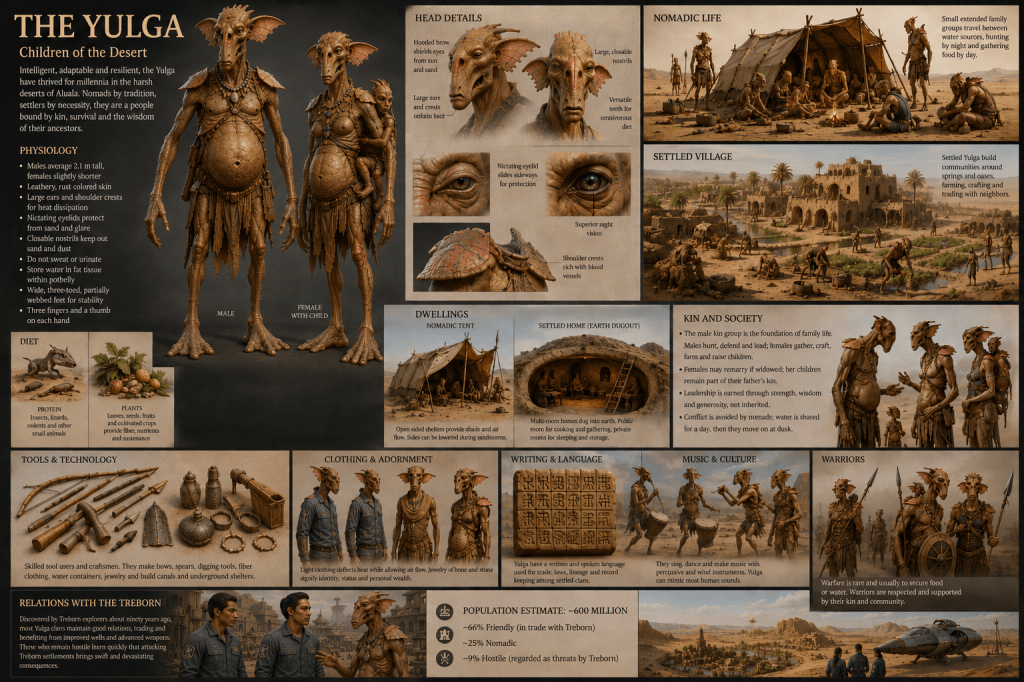
The Yulga
The Yulga are an intelligent, semi-nomadic peoples native to the Treborn held world of Aluala. They are bipedal humanoids, males averaging 2.1 meters tall, females slightly shorter. They have long, skinny legs and arms, but a potbelly that houses water laden fat tissue stomachs. Their skin is leathery, rust colored and hairless. Their feet are wide and flat, almost web like between three toes. They have three fingers and a thumb on each hand, also long and skinny. They have a two cartaliganous shoulder crests riddled with blood vessels, and large, wide ears with similar features to help with body cooling. They have a hooded brows to protect their large eyes and nictating eyelids from heat and sand, as well as large, nostrils that can also close up against sand. They have long, horse like faces with small mouths and versatile teeth well suited for their omnivorous diet. By nature, they are nocturnal and have superior night vision and hearing. They do not sweat, nor do they urinate.
Yulga are omnivores who eat small insect, lizard and rodent like animals for protein as well as the fibrous leaves, seeds and fruit of a range of indigenous plantlife. Settled populations raise more productive, carefully cultivated varieties of these plants around carefully constructed oases or natural springs.
Yulga have two sexes and bear live children. Females will nurse the child for twelve months while it is helpless and unable to walk. Afterwards, it is weaned but often still carried. Yulga become sexually mature around age twenty. Life expectancy is about sixty-five for nomadic Yulga, and seventy-five for settled Yulga, though settled Yulga are far more likely to die young due to warfare against competing clans. Females are fertile year round but typically only bear one child every four years with fertility ending around age forty-five.
Yulga nomads live in small, extended family groups that wander the desert wastelands of their homeworld travelling from one natural spring or water cache to another, taking advantage of the plants and animals that grow there or of the succulents that can endure the arid lands between. Households consist of one or more male siblings, their female mates, adult male sons and any minor children. Males scout, hunt and defend the group, females carry young and supplies, and help with crafting and food gathering.
Yulga families in settled communities parallel the nomadic structure, but instead of a single family group, dozens of family groups will live together in close proximity. Men and women alike become farmers and the role of hunters and defenders typically fall upon the males of one or two households, who the other families support. The eldest male of the strongest of these households becomes the community leader, but there is no inheritance of that role, at least, not formally, though the son of a warrior often becomes a warrior.
The male kin group is the foundation of the family, with male siblings supporting each other and one another’s children in times of hardship. When a male comes of age, he and his brothers will attempt to persuade an unattached female of another lineage to become his mate, usually through gifts of meat, clothing and other crafted goods that demonstrate the wealth of the kin group and the prowess of the man. If agreeable, the female joins the kingroup, becoming one male’s spouse, but should be die, she has the option to remain with that group, raising her husband’s children within it, or to remarry into another kin group, taking any minor daughters with her. Her late husbands brothers will look after her and her children for as long as they are part of that family.
Yulga are skilled tool users, crafting bows, spears, digging tools, plant fiber clothing, water containers from animal bladders, digging canals and underground shelters in their permanent shelters, resting beneath hide tents or in shallow dug or natural caves if nomadic. They make bone and stone jewelry, but lack metalworking. They have a written language used extensively by settled clans for trade, taxation, and recording laws and lineages.
Yulga nomads spend their days in tent shelters that are kept open sided except during sandstorms, then the sides can be dropped down for additional protection. Each tent is built for a a pair of adults and their children. Settled Yulga live in carefully crafted, multi room homes dug out from the earth. They will have a public room for cooking and relaxation, and a private room for sleeping and wealth storage. Some will have a second sleeping room if a male is hosting a fallen brother’s ex and children.
Yulga have personal and clan names. Tools, weapons, jewelry and even tents are personally owned, as are garden plots in a village. Yulga have a written and spoken language. They wear light clothing that is designed to deflect heat while allowing shoulder fins and ears to help cool the body as well. Yulga styles tend to be modest by human standards, but are open backed. Yulga sing, dance, and make music with percussive and wind instruments. They can mimic most human sounds and humans can mimic most of theirs.
Yulga nomads avoid conflict, as they own nothing more than they can carry, and see little worth fighting over. If one group comes across an already occupied waterhole, it is customary they they be allowed to share for the day, take what they can carry, then move on the next dusk.
Yulga villages do sometimes go to war, most often in times of food shortage or drought. These aren’t commonly wars of conquest, but wars to steal provisions from a neighbor. And some villages, with greater numbers than it’s neighbors, can even coerce regular tribute from nearby villages, the leader of the stronger village becoming, in essence, a king. In some regions, these kings have a very great reach, and nomads are often driven away when they wander into such lands.
Treborn explorers discovered the Yulga about ninety years ago. They have good relations with many kings, having reinforced their wealth, improving depth and quality of wells and upgrading the armament of those friendly to their colonies. Unfriendly Yulga tend to suffer badly should they attack Treborn mining settlements. It is estimated that close to 600 million Yulga live on their homeworld. About two thirds of these are “friendlies” and a quarter are nomads. About fifty million Yulga live in areas that Treborn have deemed hostile due to the belligerence of those clans and settlements.

The Sperken
The Sperken are an intelligent peoples native to the Humanis held world of Nhwiren. They are quadrupedal “flying” mammals whose males average 1 meter long and females about 0.9 meters long. They have short hind legs and long forelegs with a large flap of skin between them giving them a triangular shape while in flight. They have three fingers plus two poseable thumbs on the outside edge of each foot/hand, and a long prehensile tail. All five of these body parts can be used for gripping, though only the hands and feet are suitable for fine manipulation. They have narrow, hooded eyes with a protective nictating membrane and constantly seem to be weeping to keep their eyes clear. They have large, pointed ears which help with echolocation, and six wide nostrils down the center of their long, triangular face, through which they breathe, communicate and consume food. They have no mouths or vocal chords. Their dark brown skin is leathery and hairless except along the center of the back, chest and lower abdomen, which is covered in short hair, typically a light brown.
Sperken are terrestrial filter feeders who consume pollen and tiny insects that constantly fill the air of their homeworld. While humans must wear filter masks in this otherwise perfectly breathable atmosphere, to the Sperken, the air of their home is a veritable smorgasborg! Gliding from tree to tree, they suck nourishment in through their nostrils, and if the air is still for some reason, they will tear open flowers or spore galls and snort out nutrition directly. While the natural Flora is plentiful, Sperken also deliberately seed wide areas to ensure the seasonal cycles of plants are always kicking up pollen for consumption.
Sperken have two sexes and bear live children. Females will nurse the child for three weeks until they learn to fly, leaving them at home under the father’s or some other kin’s protection while the mother eats. Afterwards, the young fly at their parent’s side. Sperken become sexually mature around age five. Life expectancy is about thirty-five. Females are fertile year round but typically only bear one child each year, but remain fertile from puberty until death.
Sperken live in small, sedentary groups of related families. Each of these settlements will cultivate a region about three hours flight from home. Nests, or homes, are built in high treetops or along protected and nearly inaccessible cliff faces where a male and female pair will live with their prebuscent offspring.
The nuclear family is the foundation of society. When Sperken come of age, a male and female will court each other, and after flying alongside and singing to each other for many days, will ultimately build a nest together and remain a couple, usually for life, though it is not unheard of for couples to split from each other over matters of infidelity. Sexual relations are expected to be exclusive to one’s spouse. A male’s reputation as an athlete or a “killer of dangers” often weighs heavily in his favor, but a good singer is also adored.
The larger colony is led through consensus, with elder members suggesting seeding needs and nesting site migrations, or even occasional ground projects such as the construction of irrigation canals. Families who disagree with the community consensus are free to leave and find another community or start their own, elsewhere…but beyond the current one’s flight range.
Sperken don’t use a lot of tools in daily life, so their intelligence was long overlooked. However, they will shape digging tools for canal work, punching tools to crack open spore galls, hollow out gourds to store water for tines of drought, and they even collect shiny objects with which to decorate their nests, where they weave sleeping hammocks. They don’t use fire or practice metallurgy, but use wood and stone tools. Many Sperken are skilled flintknappers and will craft stone tipped arrows and darts.
They spend little time on the ground, generally, they will keep their tail wrapped around a nearby branch if they have to land, so they can leap and catapult up into the air. They are not true “flyers”, but skilled gliders, propelling themselves upward with their powerful tails and forearms, using hind feet to carry any needed tools.
Sperken communicate through song, whistling in many ranges, not all of which are audible to humans, and share not just practical information, but also lineages, myths, stories both historic and fanciful, and ballads of love and loss. Trey also possess a written tongue, primarily used to denote territorial markers, and track seasons, recording when different areas within their region should be best to visit, and noting variances in productivity over time to help decide whether new plantings are needed.
Sperken have personal names and will often compete with each other in aerial sports, tossing gourds about, seeking to disrupt each other’s flight or score a precise hit on a target, generally a ground predator. These games are matters of pride and prowess, and often carry wagers over pieces of art and songs of submission to the victor. Rarely is any injury to a fellow Sperken intended.
Sperken do not wear clothing, but their fur provides natural modesty to the extent Sperken desire.
Sperken rarely wage war against each other, and then only to establish territorial dominance and force a competing community to relocate rather than to exterminate or rule. However, aerial predators are ruthlessly hunted whenever they are seen near Sperken territory. Ground predators are also routinely killed, especially those that can climb, just to make sure that if a Sperken lands to work on a canal, or crack open a termite nest, or a spore gall, they aren’t likely to get taken by surprise.
Humanis explorers didn’t realize the Sperken were an intelligent race until roughly 52 years ago. Humanis knew there were sentients present on the world, but as Sperken rarely carry tools, they were not suspected. No action has been taken against them as they do not seem to be a threat to human settlement.
The Conclave now estimates there may be close to 200 million Sperken on Nhwerin. It seems they would be unlikely to be useful for off world colonization and would require exosuits to properly feed themselves elsewhere, however, their aerial skills and small size has caused discussion about the possibility of training them as pilots. Nhwerin themselves seem disinterested in leaving their homeworld.


Leave a Reply